

Saving money sounds simple until you actually try to do it consistently.
Most advice you find online falls into two categories — either so obvious it is useless (“stop buying coffee”) or so extreme it is unsustainable (“live on ₹5,000 a month”). Neither helps the average Indian earning a decent salary who genuinely wants to save more but cannot figure out where the money keeps disappearing.
This post is different. These 15 tips are practical, specific, and work within the reality of everyday Indian life in 2026 — rising costs, UPI making spending invisible, EMI culture, and the endless pull of online shopping.
Some of these will save you hundreds. A few will save you thousands. None of them require you to stop enjoying your life.
⚠️ Disclaimer: This article is for educational purposes only and does not constitute financial advice. Please consult a qualified financial advisor for personalised guidance.
Why Most People Struggle to Save
Here is the uncomfortable truth — most people do not have a savings problem. They have a visibility problem.
When money comes in and goes out through UPI, auto-debits, credit cards, and subscriptions, spending becomes invisible. You never physically hand over cash, so you never feel the weight of what you are spending. By the time the month ends, the money is gone and the mental accounting is fuzzy.
The second problem is the saving-what-is-left approach. Most people spend first and try to save whatever remains at the end of the month. There is rarely anything left. Saving works the opposite way — you save first and spend what remains. That single reversal changes everything.
With those two truths in mind, here are 15 tips that address both problems directly.
15 Practical Money-Saving Tips That Actually Work
1. Set Up an Automatic SIP on Salary Day
The most powerful saving habit you can build is one that requires zero willpower — because it happens automatically before you get a chance to spend.
Set up a SIP (Systematic Investment Plan) in a mutual fund or a recurring deposit that triggers on the same day your salary arrives. Even ₹1,000 to ₹2,000 per month moved automatically into a separate account on day one changes your relationship with money fundamentally. You adjust to spending what is left rather than trying to save what is left.
If you are not sure where to start with mutual funds, our beginner’s guide to investing in mutual funds in India walks through the entire process step by step.
2. Audit Your Subscriptions Right Now
Open your bank statement and look at every recurring charge from the last three months. Most people are genuinely surprised by what they find.
Streaming services you forgot you signed up for. App subscriptions from a free trial that converted to paid. Cloud storage plans, music apps, news subscriptions — each one individually is small. Together they often add up to ₹1,500 to ₹4,000 per month for services you use occasionally or not at all.
Cancel everything you have not actively used in the last 30 days. You can always resubscribe if you genuinely miss something.
3. Use the 48-Hour Rule for Online Shopping
Online shopping in India has made impulse buying effortless. Something catches your attention, it is in your cart, it is delivered tomorrow. The entire process is designed to bypass the part of your brain that weighs whether you actually need something.
The 48-hour rule is simple — when you feel the urge to buy something that is not an essential, add it to your wishlist instead of your cart and wait 48 hours. The majority of the time, the desire fades. When it does not fade after 48 hours, it is probably a genuine want rather than an impulse.
This one habit can save ₹2,000 to ₹6,000 per month for heavy online shoppers without requiring you to deprive yourself of anything you truly wanted.
4. Switch to Annual Plans for Services You Actually Use
For subscriptions you genuinely use and want to keep — streaming platforms, cloud storage, productivity tools — switching from monthly to annual billing typically saves 20 to 40 percent. That is real money for simply paying upfront.
Do the maths on the three or four subscriptions you actually use regularly. The saving on annual billing alone often covers the cost of one or two of the smaller subscriptions entirely.
5. Separate Your Spending Money from Your Savings
Having all your money in one account is a psychological trap. When you see ₹50,000 in your account, your brain registers that as available money — even if ₹30,000 of it is earmarked for bills, rent, and savings.
Open a second zero-balance savings account (most Indian banks offer this for free) and transfer your monthly savings target there on salary day. Out of sight genuinely means out of mind, and keeping spending money separate from savings money eliminates the constant temptation to dip into savings for small expenses.
6. Track Every Expense for One Month
You do not need to track expenses forever — just do it seriously for one full month. Use an app like Walnut or ET Money that reads your SMS transactions automatically, so there is no manual effort involved.
At the end of that month, look at your spending by category. Most people find two or three categories where spending is significantly higher than they thought — usually food delivery, entertainment, or convenience spending. That single month of visibility gives you a clear, data-based picture of where your money actually goes versus where you think it goes.
The difference between those two numbers is your saving potential.
7. Cook at Home at Least Four Days a Week
Food delivery is one of the biggest invisible drains on urban Indian spending in 2026. A meal that costs ₹80 to cook at home costs ₹250 to ₹400 when ordered through Swiggy or Zomato after platform fees, delivery charges, and the restaurant markup built into delivery pricing.
If you order food five times a week and cook instead for four of those five, the saving over a month is significant — often ₹3,000 to ₹6,000 — without eliminating the treat of ordering once a week.
This is not about sacrifice. It is about proportion.
8. Use Credit Cards Strategically — Not as Extra Income
Credit cards are excellent tools when used correctly and genuinely dangerous when not. The correct use is simple — spend only what you already have in your bank account, pay the full balance every single month, and collect the rewards and cashback.
The incorrect use is treating the credit limit as an extension of your income. Credit card interest rates in India range from 36 to 48 percent annually — among the highest of any financial product available. A single month of carrying a balance erases months of cashback rewards and puts you in a cycle that is genuinely difficult to escape.
Pay the full amount. Every month. Without exception.
9. Negotiate Your Bills — More Than You Think Is Possible
Most people never negotiate recurring bills because it feels uncomfortable or they assume it will not work. It works more often than you expect.
Call your internet provider and ask for a better plan — providers regularly offer retention deals to customers who ask. Check whether your insurance premiums can be reduced by increasing your deductible. Ask your gym if they have an annual membership rate lower than twelve times the monthly fee. The worst answer you get is no, and the best answer saves you thousands per year.
Negotiating your existing bills is free money that requires one phone call.
10. Buy Generic for Everyday Products
For everyday consumables — cleaning products, basic groceries, medicines, stationery — generic or store-brand versions perform comparably to branded ones at 30 to 60 percent lower cost.
The premium you pay for most branded everyday products is almost entirely marketing, packaging, and shelf positioning. For items where brand actually matters to you — keep buying them. For items where it genuinely does not matter, switching to generic is a painless, permanent saving.
11. Plan Your Grocery Shopping with a List
Grocery stores and supermarkets are designed with considerable thought about how to get you to buy things you did not plan to buy. End-of-aisle displays, strategic product placement, and bulk-deal packaging all work on the same principle — grab attention at the point of purchase.
Shopping with a specific list, having eaten beforehand, and sticking to the list strictly is one of the simplest and most effective ways to reduce grocery spending without buying less of what you actually need. Studies consistently show that unplanned grocery purchases account for 20 to 40 percent of the total grocery bill.
12. Review Your EMIs Annually
If you have home loan, car loan, or personal loan EMIs, review them once a year with fresh eyes. Interest rates change, your credit score may have improved, and refinancing options that were not available when you took the loan may now save you significantly.
Even a reduction of 0.5 percent on a ₹30 lakh home loan translates to meaningful savings over the remaining tenure. Most people set up their EMIs and never revisit them — that passivity is expensive.
13. Invest Your Savings Immediately — Do Not Let Them Sit
Saving money into a regular savings account and leaving it there is not enough in 2026. Inflation in India consistently erodes the purchasing power of money sitting in a savings account earning 3 to 4 percent interest.
The moment savings accumulate, move them into instruments that work harder — even a simple liquid mutual fund earns meaningfully more than a savings account with comparable accessibility. Money sitting idle in a savings account is money slowly losing value.
14. Use Cash for Discretionary Spending Categories
For categories where you consistently overspend — eating out, shopping, entertainment — try withdrawing a fixed cash budget for that category at the start of the month and spending only that cash.
UPI and cards make spending feel abstract. Cash feels real. When you physically see the notes reducing, spending decisions feel more concrete. Many people find that switching to cash for just two or three categories reduces their spending in those categories by 20 to 30 percent without any other change.
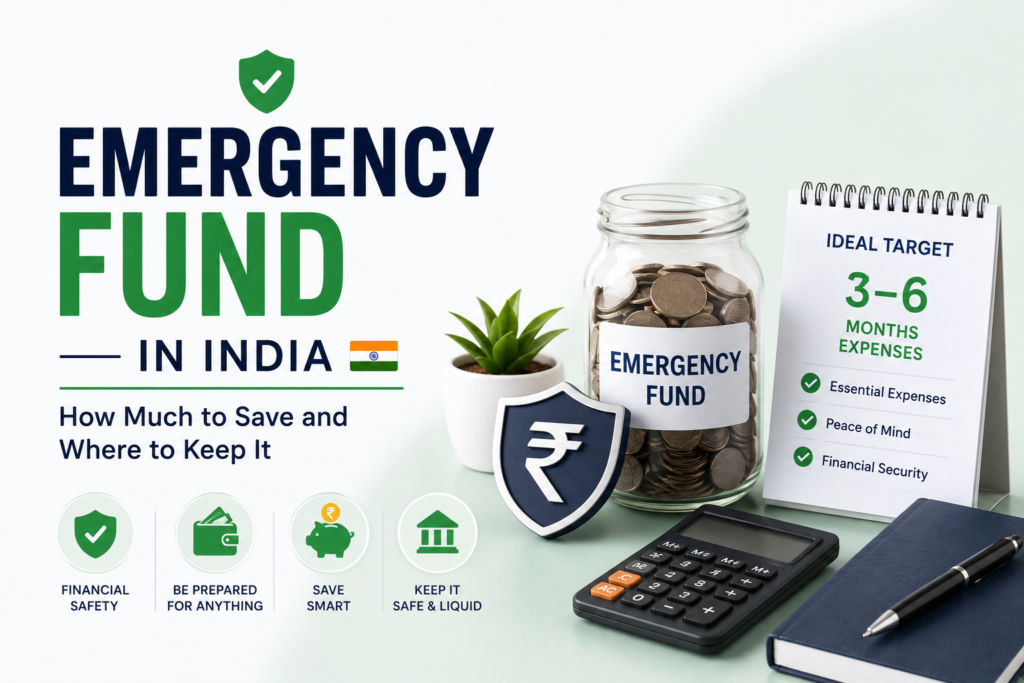
15. Build an Emergency Fund Before Everything Else
This is not a tip that saves you money today. It is the tip that prevents you from losing everything you saved tomorrow.
Without an emergency fund, every unexpected expense — a medical bill, a job loss, a car repair — gets paid by breaking a fixed deposit, withdrawing from investments at the wrong time, or going into debt. Each of those options is costly in different ways.
Build three to six months of living expenses in a liquid account before aggressively investing elsewhere. It is the financial foundation that makes every other saving habit stable.
The 50-30-20 Rule — A Simple Framework
If the idea of budgeting feels overwhelming, the 50-30-20 rule gives you a simple starting structure:
50% of your income goes to needs — rent, groceries, utilities, EMIs, transport.
30% goes to wants — dining out, entertainment, shopping, travel, subscriptions.
20% goes to savings and investments — before you spend anything in the other categories.
Adjust the percentages based on your income and city. Someone in Mumbai paying high rent may need 60 percent for needs and 10 percent for wants. Someone with lower fixed costs may push savings to 30 percent. The framework is a starting point, not a rigid rule. What matters is having a framework at all.
Small Savings, Big Results — The Numbers
Here is a simple illustration of what consistent saving actually produces over time, assuming an 12 percent annual return through equity mutual funds:
| Monthly Saving | 5 Years | 10 Years | 20 Years |
|---|---|---|---|
| ₹2,000 | ₹1.6 lakh | ₹4.6 lakh | ₹19.8 lakh |
| ₹5,000 | ₹4.1 lakh | ₹11.6 lakh | ₹49.6 lakh |
| ₹10,000 | ₹8.2 lakh | ₹23.2 lakh | ₹99.9 lakh |
The numbers are not magic — they are just compounding doing what compounding does when given enough time. The variable you control most is when you start. Starting with ₹2,000 per month today is worth more than starting with ₹5,000 per month three years from now.
Final Thoughts
Saving money is not about restriction. It is about intention — deciding in advance where your money goes rather than wondering where it went.
None of the fifteen tips in this post require you to live uncomfortably or give up things that genuinely matter to you. They require paying attention, making a few one-time changes, and building two or three small habits that run in the background of your life.
The goal is not to save for its own sake. The goal is the freedom and security that comes from having money working for you instead of spending your entire life working for money.
Start with three tips from this list. Apply them this week. Build from there.
Key Takeaway
Most Indians do not have a savings problem — they have a visibility problem. Automate your savings on salary day, audit your subscriptions, apply the 48-hour rule to online shopping, and track your expenses for one month. These four habits alone will reveal and redirect thousands of rupees per month. Small, consistent actions compounded over time produce results that feel extraordinary — but are simply the result of starting early and staying consistent.