
Every year, millions of Indians file their income tax return at the last minute, in a panic, clicking through screens they do not fully understand and hoping for the best.
It does not have to be that way.
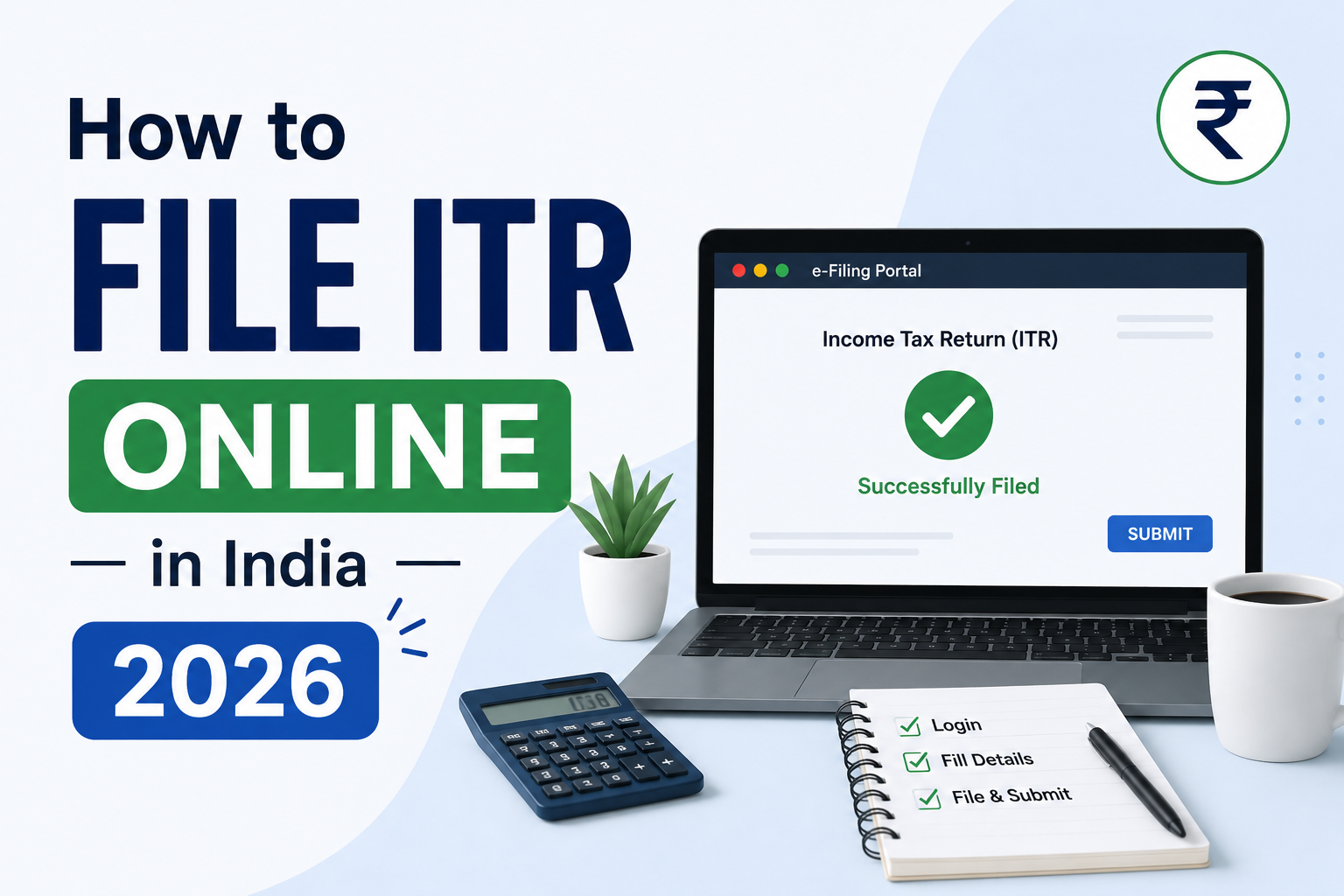
Filing your ITR online in India has become significantly simpler over the last few years. The Income Tax Department’s e-filing portal walks you through most of the process automatically — pre-filling your salary details, calculating your tax liability, and guiding you step by step. If you have all your documents ready and understand which form applies to you, the actual filing takes 20 to 30 minutes.
This guide covers everything — what ITR is, who needs to file it, which form to use, what documents you need, the complete step-by-step filing process for FY 2025-26 (AY 2026-27), and the most common mistakes that cause notices and refund delays.
⚠️ Disclaimer: This article is for general educational purposes only and does not constitute professional tax advice. Tax rules change frequently. For complex income situations — business income, capital gains, foreign assets — please consult a qualified Chartered Accountant.
Note: This guide is for FY 2025-26 (Assessment Year 2026-27). Due date: 31st July 2026 for salaried individuals.
What is ITR and Why Does It Matter?
ITR stands for Income Tax Return. It is a form you submit to the Income Tax Department of India declaring your income, deductions, and the taxes you have paid or owe for a financial year.
Think of it as an annual financial report card you submit to the government — it tells them what you earned, what you spent on tax-saving investments, and whether you paid the right amount of tax through TDS (Tax Deducted at Source) or advance tax.
Filing your ITR is not just a legal obligation — it is one of the most useful financial documents you can have. Banks ask for it when you apply for home loans or personal loans. Embassies ask for it when you apply for visas. It is proof of your income history and financial credibility.
Even if your income is below the taxable limit, filing voluntarily creates a clean tax record that serves you well in every significant financial decision ahead.
Who Must File ITR in India?
You are required to file ITR if any of the following apply to you for Financial Year 2025-26:
- Your total income exceeds ₹3 lakh (under the new tax regime) or ₹2.5 lakh (under the old tax regime) before deductions
- You are a company or firm, regardless of whether you made a profit or loss
- You want to claim a refund of TDS deducted from your salary, bank interest, or other income
- You have foreign assets or income from outside India
- You have made high-value transactions — deposits above ₹1 crore in a current account, foreign travel expenses above ₹2 lakh, electricity bills above ₹1 lakh in a year
- You are an NRI with income sourced in India above the basic exemption limit
Every Indian including an NRI is required to file an income tax return where total income exceeds the basic exemption limit.
Even if none of these apply to you — if you had TDS deducted from your salary or bank FD interest and want it refunded, filing ITR is the only way to claim that money back.
ITR Filing Deadlines for 2026
The Budget 2026 has extended the ITR filing deadline for non-audit businesses and trusts filing ITR-3 and ITR-4 to 31st August. The deadline for filing ITR-1 and ITR-2 will remain 31st July. For people who fall within the limits of a tax audit, the due date is 31st October, and in cases where transfer pricing is applicable, the due date is 30th November.
| Taxpayer Type | ITR Form | Deadline |
|---|---|---|
| Salaried individuals, pensioners, small investors | ITR-1, ITR-2 | 31st July 2026 |
| Business owners, freelancers (presumptive tax) | ITR-3, ITR-4 | 31st August 2026 |
| Tax audit cases | ITR-3 | 31st October 2026 |
| Transfer pricing cases | ITR-3 | 30th November 2026 |
Missing the July 31 deadline does not mean you cannot file — you can file a belated return until 31st December 2026, but with a late filing fee of ₹1,000 (if income is below ₹5 lakh) or ₹5,000 (if income exceeds ₹5 lakh). Filing on time avoids this entirely.
Which ITR Form Should You Use?
Selecting the appropriate form is considered one of the most important steps in the filing process — selecting the incorrect ITR form can lead to defective returns, penalties, and delays in refunds.
Here is a simple guide to the most commonly used forms:
ITR-1 (Sahaj) — The simplest form, for salaried individuals with:
- Income from salary or pension
- Income from one house property
- Interest income from savings account, FDs, etc.
- Total income up to ₹50 lakh
- This is the form most salaried employees in India use
ITR-2 — For individuals and HUFs with:
- Income above ₹50 lakh
- Capital gains from stocks, mutual funds, or property
- Foreign income or assets
- Income from more than one house property
- No business or professional income
ITR-3 — For individuals with income from business or profession alongside other income sources
ITR-4 (Sugam) — For individuals, HUFs, and firms opting for presumptive taxation — freelancers, small business owners, and professionals declaring income under sections 44AD, 44ADA, or 44AE
Which one is right for you? If you are a salaried employee with a single employer, some FD interest, and total income under ₹50 lakh — ITR-1 is your form. If you sold stocks or mutual funds this year — use ITR-2. If you freelance or run a business — ITR-3 or ITR-4 depending on your turnover and scheme.
Documents You Need Before You Start
Gathering these before you open the portal saves significant time and prevents incomplete filings:
Essential for everyone:
- PAN card
- Aadhaar card (linked to your mobile number for OTP verification)
- Bank account details (account number and IFSC code)
- Form 26AS — your Tax Credit Statement showing all TDS deducted on your behalf
- AIS (Annual Information Statement) — a comprehensive statement of all financial transactions linked to your PAN
For salaried employees:
- Form 16 — issued by your employer, summarises your salary and TDS deducted (employers must provide this by June 15)
- Form 16A — for TDS on income other than salary (bank interest, rent, etc.)
For investors:
- Capital gains statement from your broker (Zerodha, Groww, etc.) for stocks and mutual funds sold during the year
- Dividend income details
For home loan holders:
- Interest certificate from your bank or NBFC showing principal and interest paid
- Property address and co-owner details if applicable
For tax-saving investments (if using old regime):
- 80C investment proofs — LIC premium receipts, ELSS statements, PPF passbook, home loan principal
- 80D — health insurance premium receipts
- 80G — donation receipts for eligible charitable organisations
Before you start, download both your Form 26AS (Tax Credit Statement) and your AIS (Annual Information Statement) from the e-filing portal and cross-check every entry against your bank statements, Form 16, and broker capital gains statements. Mismatches between your filing and these documents are a primary trigger for income tax notices.
Step-by-Step: How to File ITR Online in 2026
Step 1 — Log in to the Income Tax e-Filing Portal
Go to incometax.gov.in — the official Income Tax Department portal. Click on Login in the top right corner. Enter your PAN number as your User ID and your password. If this is your first time, click Register and complete the registration using your PAN and Aadhaar.
Step 2 — Download Form 26AS and AIS
Once logged in, go to e-File → Income Tax Returns → View Form 26AS and also download your AIS from the AIS tab. Cross-check the TDS figures in Form 26AS against your Form 16. Any mismatch needs to be clarified with your employer or bank before filing.
Step 3 — Navigate to File ITR
Click on e-File → Income Tax Returns → File Income Tax Return. Select:
- Assessment Year: 2026-27 (for income earned in FY 2025-26)
- Mode of Filing: Online
Step 4 — Select the Correct ITR Form
On the Income Tax Return page, select your ITR Form Number based on your income profile. The portal may suggest the appropriate form based on your profile — verify this matches your actual income situation before proceeding.
Step 5 — Choose Your Filing Status
Select whether you are filing as an Original Return (first time for this year) or a Revised Return (correcting a previously filed return).
Step 6 — Choose Tax Regime
Select between the New Tax Regime and the Old Tax Regime. This is one of the most important decisions in your filing — we cover how to choose in the next section. The portal allows you to compare both and see which results in lower tax liability before you decide.
Step 7 — Verify Pre-Filled Data
The portal pre-fills much of your data automatically — salary details from Form 16, TDS deducted, bank interest, dividend income, and more. Go through every pre-filled field carefully. Do not assume it is correct — verify each entry against your actual documents. Errors in pre-filled data are common and you are responsible for the accuracy of your filing.
Step 8 — Enter Your Income Details
Fill in all income sources:
- Salary income (from Form 16)
- House property income or loss
- Capital gains (from your broker statement)
- Income from other sources — savings account interest, FD interest, dividend income
Step 9 — Enter Deductions
If you are using the Old Tax Regime, enter your eligible deductions:
- Section 80C — up to ₹1.5 lakh (ELSS, PPF, life insurance, home loan principal, children’s tuition fees)
- Section 80D — health insurance premiums (up to ₹25,000 self, ₹50,000 for senior citizen parents)
- Section 80G — eligible charitable donations
- Section 24(b) — home loan interest up to ₹2 lakh for self-occupied property
- Section 80TTA — savings account interest up to ₹10,000
Under the New Tax Regime, most of these deductions are not available — the trade-off is lower tax slab rates.
Step 10 — Review Tax Computation
The software will do the calculations and will automatically tell you about the amount of tax to be paid or the refund you may receive. Review this carefully. If tax is due, pay it immediately through the portal via net banking or UPI (this is called Self Assessment Tax — Challan 280). If a refund is due, it will be credited to your pre-validated bank account after processing.
Step 11 — Preview and Submit
Click Preview Return to review everything one final time. Check your personal details, income figures, deductions, and tax computation. Once satisfied, click Proceed to Submit and confirm.
Step 12 — E-Verify Your Return
After filing your Income Tax Return you must e-verify it within 30 days. The e-verification process can be done using Aadhaar OTP (linked Aadhaar and mobile number required), Net Banking login via authorised banks, Pre-validated Bank Account (EVC sent to your registered mobile or email), or Digital Signature Certificate (DSC) mandatory for certain categories.
For most individuals, Aadhaar OTP is the fastest and simplest e-verification method. Your filing is not complete until e-verification is done — an unverified return is treated as not filed.
How to E-Verify Your ITR
E-verification is the final and most commonly skipped step. Here is how to do it via Aadhaar OTP — the simplest method:
- After submitting, click e-Verify Now
- Select Generate Aadhaar OTP
- An OTP is sent to your Aadhaar-linked mobile number
- Enter the OTP within 15 minutes
- Your ITR is now successfully filed and verified
You will receive an acknowledgement number — save this. It is proof that your return was filed successfully.
New Tax Regime vs Old Tax Regime — Which to Choose?
This is the question most Indian taxpayers wrestle with every year. Here is a practical framework:
New Tax Regime offers lower tax slab rates but removes most deductions. It works in your favour if your total eligible deductions under the old regime are relatively low — typically if your 80C, 80D, and home loan interest deductions together are less than ₹2 to ₹3 lakh.
Old Tax Regime has higher base rates but allows significant deductions — 80C (₹1.5 lakh), 80D (health insurance), home loan interest (₹2 lakh), HRA, and more. It works in your favour if you are maximising these deductions.
The simplest approach: use the portal’s built-in tax comparison tool when filing. Enter your income and deductions under both regimes and let the numbers decide. Choose whichever results in lower tax liability for your specific situation.
As a general rule of thumb — salaried individuals with a home loan, ELSS investments, and health insurance often benefit from the old regime. Those without these deductions typically pay less under the new regime.
Common ITR Filing Mistakes to Avoid
Filing under the wrong assessment year. Income earned in FY 2025-26 must be declared in AY 2026-27. Quoting the wrong assessment year may increase the chances of erroneous taxation. Double-check this every time.
Not downloading AIS before filing. Your AIS contains all high-value transactions the tax department knows about — stock sales, mutual fund redemptions, large deposits. If you do not report income that appears in your AIS, it triggers an automatic notice.
Choosing the wrong ITR form. Selecting the incorrect ITR form can lead to defective returns, penalties, and delays in refunds. If you sold stocks this year, ITR-1 is not the right form — use ITR-2.
Not reporting all income. Bank FD interest, savings account interest above ₹10,000, dividend income, freelance payments — all of these are taxable and must be declared even if TDS was already deducted.
Claiming deductions without documents. Claiming deductions without possession of valid supporting documents may attract a notice from the Income Tax Department. Keep all investment proofs, insurance receipts, and donation certificates for at least six years.
Forgetting to e-verify. A filed but unverified return is treated as not filed at all. Not e-verifying your return within 30 days of filing makes the return invalid.
Not reconciling Form 26AS with Form 16. If the TDS figures do not match, file only after getting the discrepancy resolved with your employer. Filing with mismatched data is a notice trigger.
Benefits of Filing ITR Even if Not Mandatory
Many people with income below the taxable limit skip filing entirely — and miss out on these genuine benefits:
Claim TDS refunds. If your bank deducted TDS on FD interest but your total income is below the taxable limit, filing ITR is the only way to reclaim that money.
Easier loan approvals. Banks typically ask for the last two to three years of ITR when processing home loans, car loans, and business loans. No ITR means no paper trail of income — which means higher scrutiny and often rejection.
Visa applications. Many countries — UK, USA, Schengen, Canada — ask for ITR filings as part of the visa documentation process. Consistent ITR filings strengthen your application significantly.
Carry forward losses. If you made a loss on stock market investments this year, filing ITR allows you to carry that loss forward and offset it against future capital gains — reducing your tax liability in future years. This benefit is only available if you file before the due date.
Financial credibility record. A consistent ITR filing history is one of the most useful financial records you can maintain. It documents your income growth over years and provides verified proof of earnings for every significant financial decision.
Final Thoughts
Filing ITR is one of those things that feels more intimidating than it actually is — particularly the first time. Once you have done it once, understood which form applies to you, and know where your documents come from, subsequent years take 20 to 30 minutes.
The key is preparation — having your Form 16, Form 26AS, AIS, and investment proofs ready before you log in. The portal handles the calculations. Your job is to ensure the information going into it is accurate and complete.
Timely filing of an ITR helps you avoid penalty but also makes loan disbursement, visa application, and refunds easier. There is no good reason to delay it past July 31 if you are a salaried individual — and several good reasons to file as early as you can.
Key Takeaway
Filing ITR online in India for FY 2025-26 (AY 2026-27) must be done by 31st July 2026 for salaried individuals on incometax.gov.in. Use ITR-1 if you are salaried with income under ₹50 lakh and no capital gains. Gather Form 16, Form 26AS, AIS, and investment proofs before starting. Compare new vs old tax regime in the portal and choose based on your deductions. Always e-verify within 30 days of filing — without e-verification your return is invalid. Filing on time avoids penalties and unlocks loan approvals, visa applications, and TDS refunds.