
When the COVID-19 lockdown hit in March 2020, millions of Indians faced a situation they were completely unprepared for — income stopped, expenses did not.
What happened next was painful and entirely avoidable. People redeemed equity mutual funds at 30 to 40 percent losses to pay rent and groceries. They borrowed from family at the cost of relationships. They took personal loans at 18 to 24 percent interest to cover basic living expenses. They sold gold. They broke FDs before maturity and paid penalties.
Not because they had not saved. Many of these people had SIPs, had invested in stocks, had kept money in their PPF. They had been doing the right things financially. But they had no emergency fund — no dedicated, liquid, separately maintained pile of money whose only job was to be available the moment something went wrong.
In one crisis, years of disciplined investing was undone. They lost both the security they needed immediately and the compounding growth they had been building for years.
That is what the absence of an emergency fund actually costs — not just the inconvenience of a difficult month, but the destruction of everything you built financially before it.
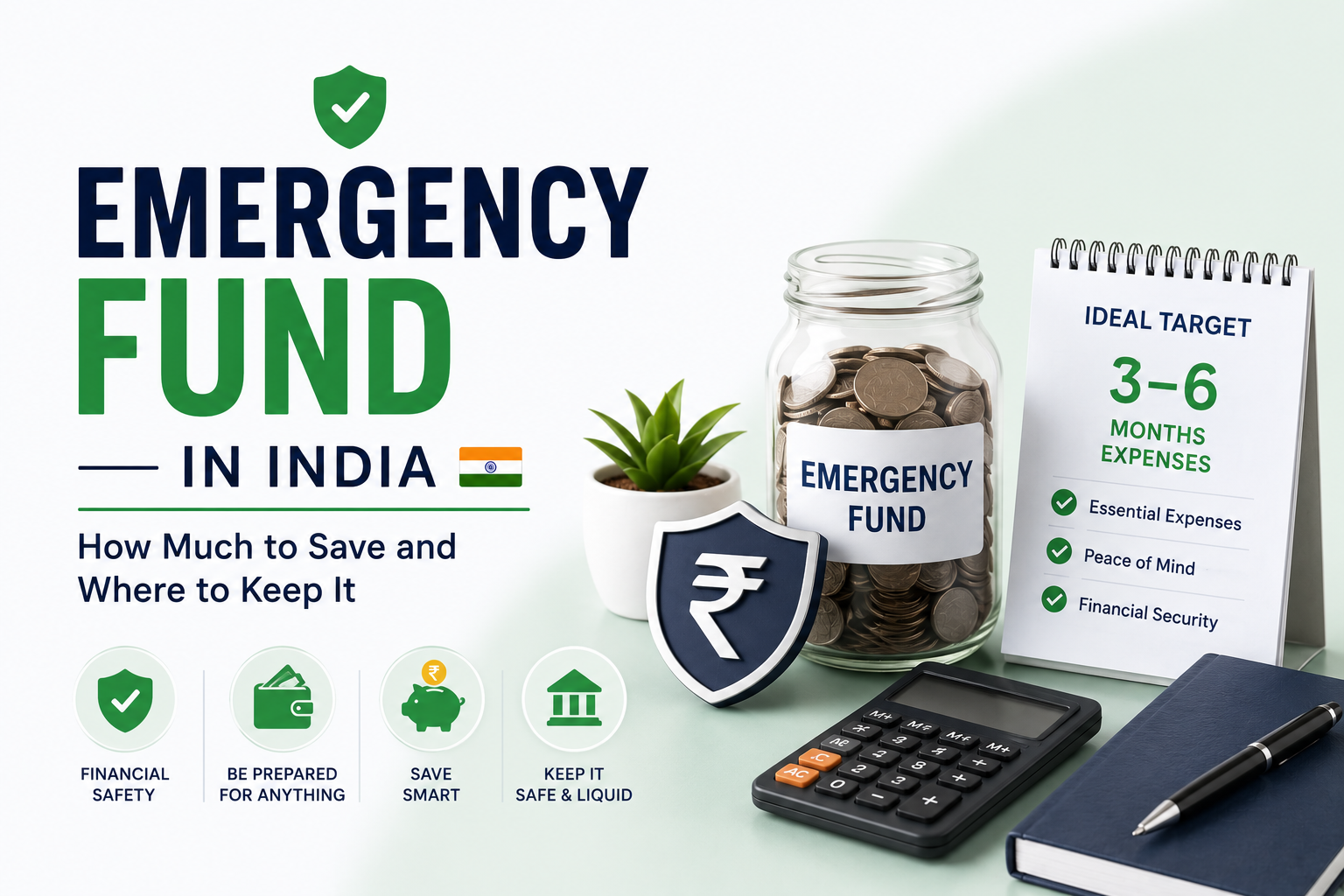
This guide covers exactly how much you need in India in 2026, how to calculate your specific number, and the best places to keep it so it is safe, accessible, and not quietly losing value to inflation.
⚠️ Disclaimer: This article is for educational purposes only and does not constitute financial advice. Please consult a qualified financial advisor for personalised guidance.
What an Emergency Fund Actually Is (And What It Is Not)
An emergency fund is a dedicated pool of money kept separately from all your other savings and investments, whose only purpose is to cover genuine, unexpected financial disruptions — job loss, medical emergency, urgent family need, sudden major expense — without forcing you to borrow money, break investments, or make panicked financial decisions under pressure.
Three words define what it must be at all times: liquid, safe, and accessible.
Liquid means you can get to the money within 24 to 48 hours without penalties or complicated processes. Safe means the principal amount does not decrease — no market exposure, no volatility. Accessible means it is in an account you can reach on a Sunday night when the banks are closed and something urgent has happened.
What it is not — an investment, a savings goal, a place to park money for a planned expense, or a fund you dip into for sales, travel deals, or festival shopping. The moment you start treating your emergency fund as a flexible savings buffer for non-emergencies, it stops being an emergency fund and becomes a leaky bucket.
The job of this money is not to grow. The job of this money is to be there — fully, reliably, immediately — when everything else is going wrong. That is a different job than most of your money has, and it requires keeping it in different places.
Why India in 2026 Specifically Demands One
Every country benefits from emergency savings. But India in 2026 has specific structural realities that make an emergency fund not just helpful but genuinely essential for financial survival.
India has no universal social security system. There is no government safety net that replaces your income if you lose your job, covers your medical bills if you are hospitalised, or pays your rent if you face an income disruption. What other countries take for granted as public infrastructure, Indian households must build entirely on their own.
Beyond that structural gap, three specific 2026 realities increase the urgency:
Healthcare costs are rising faster than general inflation. Healthcare costs in India are rising at approximately 14 percent per year — nearly three times the general CPI inflation rate. Out-of-pocket medical expenses account for nearly 60 percent of total healthcare spending in India. A single unexpected hospitalisation — even with health insurance — can leave you with ₹50,000 to ₹2 lakh in uncovered expenses, from admission deposits, non-covered procedures, medicine costs, and post-discharge care.
Job security is not what it appears. In sectors like IT and startups, prone to layoffs during global downturns, the average job search takes 3 to 6 months. Without a buffer, your options are grim — raid long-term investments at possibly the worst market moment, take a personal loan at 15 to 20 percent interest, or turn to family and friends, none of which are ideal.
Your emergency fund loses real value if you ignore inflation. A ₹10,000 emergency fund built in 2022 may only be worth ₹8,000 in real terms by 2026 — India’s healthcare inflation is running at 12 to 14 percent annually, while general inflation is 5 to 6 percent. This means your emergency fund needs to grow every year even if you never use it.
These are not hypothetical risks. They are the everyday financial reality of living in India — and they make a well-maintained emergency fund one of the most practical and important financial decisions you can make.
The 3-6-12 Rule — How Much Do You Need?
The standard advice is 3 to 6 months of expenses. The honest answer is that it depends on your specific situation. Here is how to think about which number applies to you:
3 months — if:
You have a stable salaried job in a large company with low layoff risk. You are single with no dependents. You have strong health insurance coverage and no major chronic health conditions. You have family in the same city who could provide short-term support in a genuine crisis. You have other liquid assets (not locked in equity) that could supplement an emergency fund if needed.
6 months — if:
You have dependents — children, elderly parents, a spouse who does not earn. You have an EMI — home loan, car loan, personal loan — that must be paid regardless of what happens to your income. You work in a sector with moderate job market volatility. You have known health conditions that might require sudden medical expenses. This is the right target for most salaried Indians.
9 to 12 months — if:
For those with dependents, variable income, or approaching retirement, the recommended target rises to 9 to 12 months. If you are self-employed, run a business, or freelance — your income can disappear for 2 to 3 months at a stretch without warning. The standard 3 to 6 month recommendation was built for salaried employees with predictable income. It dramatically underestimates the buffer needed by anyone whose income varies month to month.
If your income is variable, double the standard recommendation. The ₹3.3 lakh six-month emergency fund sounds safe until you are in month 7 with no clients and scrambling to sell mutual funds at a loss.
Running TechNextHub as an agency, Vrushali — this applies directly to you. Agency income has seasonality, client payment delays, and revenue variability that a salaried professional does not face. A 9 to 12 month emergency fund is the right target for any business owner or entrepreneur.
How to Calculate Your Exact Emergency Fund Target
The calculation is straightforward but most people get it wrong by including the wrong expenses.
Your emergency fund target is based on essential monthly expenses only — not your total monthly spending. Essential means what you absolutely must pay to keep your life running — not what you typically spend.
Here is how to calculate it:
Step 1 — List your essential monthly expenses only:
| Expense | Monthly Amount |
|---|---|
| Rent or home loan EMI | ₹_______ |
| Groceries and essential food | ₹_______ |
| Electricity, water, gas | ₹_______ |
| Mobile and internet | ₹_______ |
| Petrol or commute | ₹_______ |
| School fees or education EMIs | ₹_______ |
| Health insurance premium | ₹_______ |
| Other loan EMIs (car, personal) | ₹_______ |
| Essential medicines | ₹_______ |
| Total Essential Monthly Expenses | ₹_______ |
Step 2 — Multiply by your target months:
If your total essential monthly expenses are ₹45,000 and you need a 6-month fund — your target is ₹2,70,000.
Do not include dining out, subscriptions, shopping, entertainment, gym fees, or any discretionary spending in this calculation. During an emergency you stop those expenses immediately. Your fund only needs to cover what you genuinely cannot stop paying.
Step 3 — Write the specific rupee number down.
A vague “I should save more” produces nothing. A specific “I need ₹2,82,000 by December 2026” creates a plan.
Where to Keep Your Emergency Fund — The 3-Tier System
Where you keep your emergency fund matters as much as how much you save. The goal is a combination of immediate accessibility and reasonable returns — because money sitting in a savings account at 3 percent while inflation runs at 6 percent is quietly losing purchasing power every year.
The most practical approach is to split your emergency fund across three tiers based on how quickly you might need the money:
Tier 1 — Instant Access (1 to 2 months of expenses)
Where: A dedicated savings account — separate from your salary account — at a reliable bank.
Why: This is your day-zero money. Rent is due tomorrow, a medical admission deposit is needed tonight, an urgent expense cannot wait. You need this accessible within minutes via UPI or net banking.
Returns: Savings accounts return 3 to 4 percent annually. Provides instant access for immediate needs. Keep this portion for expenses you might need within 24 hours.
Key action: Open a separate savings account — different from your salary account — specifically labelled as your emergency fund. This single step creates the psychological separation between emergency money and everyday spending.
Small finance banks like ESAF, Ujjivan, and AU Small Finance Bank currently offer savings account interest rates of 6 to 7 percent — significantly higher than the 3 to 4 percent offered by large commercial banks — while remaining RBI-regulated and covered by DICGC deposit insurance up to ₹5 lakh. Worth considering for your Tier 1 account.
Tier 2 — Next-Day Access (2 to 3 months of expenses)
Where: Liquid mutual funds — specifically, direct plans of liquid funds from reputed AMCs.
Why: Liquid funds invest in very short-term, high-quality debt instruments. They are not exposed to equity markets. Redemptions are processed within one business day (T+1). They earn meaningfully more than savings accounts without any real risk to your principal.
Liquid fund returns as of March 2026 — PGIM India Liquid 6.35 percent, Mirae Asset Liquid 6.28 to 6.34 percent, Aditya Birla Liquid 6.39 percent, Axis Liquid 6.37 percent, Tata Liquid 6.37 to 6.40 percent (1-year direct growth). Always verify rates on AMC websites before investing.
This is the sweet spot of the emergency fund — better returns than a savings account, nearly as accessible, zero equity risk. Most of your emergency corpus should sit here.
Tier 3 — Short-Term Fixed Deposits (Remaining amount for larger funds)
Where: Short-term FDs with sweep-in facility, or laddered FDs of 3 to 6 month duration.
Why: For people targeting a larger corpus (6 to 12 months), parking a portion in FDs earns a slightly better rate than savings accounts while keeping the money in a familiar, guaranteed-return instrument.
FD rates as of March 2026 — SBI 6-month 5.65 percent, 1-year 6.25 percent. ICICI 6-month 5.50 percent, 1-year 6.25 percent. HDFC 1-year approximately 6.25 to 6.4 percent.
A sweep-in FD automatically transfers money from FD to your savings account when you need it — combining FD returns with savings account liquidity. Most major Indian banks offer this feature.
The Practical Split
For a ₹3 lakh emergency fund (6 months at ₹50,000/month essential expenses):
| Tier | Amount | Where |
|---|---|---|
| Tier 1 — Instant access | ₹50,000 | Dedicated savings account |
| Tier 2 — Next day | ₹1,50,000 | Liquid mutual fund |
| Tier 3 — Short-term | ₹1,00,000 | Sweep-in FD or short-term FD |
This gives you immediate access to ₹50,000 at any hour, ₹1,50,000 by the next business day, and the remaining ₹1,00,000 within 3 to 5 days — while earning a blended return of approximately 5.5 to 6 percent overall rather than the 3 to 4 percent a pure savings account would deliver.
What NOT to Do With Your Emergency Fund
These mistakes are common and each one defeats the purpose of having a fund at all:
Never keep it in equity mutual funds or stocks. Market crashes are strongly correlated with job losses and economic crises — exactly when you need the money most. During the COVID-19 crash of March 2020, the Nifty 50 fell 50 to 55 percent while thousands of Indians simultaneously faced job losses. The assets most likely to fall in value are the ones that feel most likely in every economic crisis — precisely when your emergency fund matters most.
Never keep it in PPF, ELSS, or NPS. These are excellent long-term investment instruments. They are also locked up, partially or fully, and cannot be accessed quickly in a genuine emergency.
Never merge it with your salary account. Money you can see and access tends to get spent. A separate, specifically labelled account with a slightly inconvenient transfer step creates just enough friction to preserve the fund for genuine emergencies.
Never keep it entirely in cash at home. Beyond a small amount for true day-zero emergencies (₹5,000 to ₹10,000), cash at home earns nothing and carries theft and loss risk. Keep it in the banking system.
Never use it for non-emergencies. A flight sale, a festival purchase, a vacation opportunity — these are not emergencies. If you use your emergency fund for planned or discretionary spending, you will have no fund when a genuine emergency arrives.
How to Build Your Emergency Fund Step by Step
The most common reason people never build an emergency fund is that the target number feels overwhelming. ₹2 to ₹3 lakh sitting in a savings account feels impossible when you are managing monthly expenses and EMIs and SIPs simultaneously.
The solution is not a different strategy — it is a different timeline and a different starting point.
Step 1 — Start with a ₹25,000 to ₹50,000 starter fund first
Before chasing the full 3 to 6 month target, build a small starter fund that handles the most common smaller emergencies — an unexpected medical bill, a vehicle repair, an urgent travel requirement. This takes 2 to 4 months of small transfers and gives you immediate protection against the most frequent shocks.
Step 2 — Automate a fixed transfer on salary day
Save a fixed rupee amount — not a percentage. Set ₹2,000 to ₹3,000 auto-debit on salary day. Non-negotiable. This is simpler and more consistent than calculating 10 percent every month.
Set this up today — not next month, today. The transfer should happen on the day your salary arrives, before you have any chance to spend it on other things. Even ₹2,000 per month builds ₹24,000 in a year. ₹5,000 per month builds ₹60,000.
Step 3 — Direct windfalls to the fund until the target is reached
Tax refunds, annual bonuses, incentive payments, freelance payments above your monthly average, monetary gifts — any unexpected income should go directly to your emergency fund until the target is met. This dramatically accelerates the timeline without requiring you to change your monthly budget.
Step 4 — Temporarily pause new SIP contributions if needed
If reaching your emergency fund target is taking too long, it is acceptable to temporarily reduce or pause new SIP investments and redirect that money to the fund. Emergency funds come before everything else — before SIPs, before tax-saving investments, before ELSS. A fully funded emergency fund makes your investments more sustainable — it prevents you from redeeming them at the wrong time.
Step 5 — Review and adjust annually
Your essential monthly expenses change over time — rent increases, EMIs are added or paid off, family responsibilities shift. Review your emergency fund target every year and top it up if your essential expenses have grown.
When to Actually Use It — And When Not To
Knowing when to access your emergency fund matters as much as knowing how to build it.
Use it for:
- Genuine job loss or income disruption requiring you to cover essential expenses
- Unexpected medical expenses not covered by insurance
- Urgent family financial emergency requiring immediate support
- Critical home or vehicle repair that cannot be deferred without serious consequences
- Any sudden, unplanned essential expense that cannot wait
Do not use it for:
- A planned vacation or travel opportunity
- Festival season shopping or gifts
- A sale or deal on electronics, furniture, or clothing
- A business investment or opportunity that can be planned for
- Any expense that could have been anticipated and saved for separately
Before withdrawing from the fund, pause on these questions — is this a genuine emergency or a planned expense? A wedding, a holiday, or a gadget purchase is not an emergency. Medical bills, job loss income replacement, and urgent family needs are. Is this my only option, or can the cost be deferred? Some expenses can wait 30 to 60 days. If so, try to fund the gap another way and preserve the corpus.
What to Do After You Use It
Using your emergency fund is not a failure. It is the fund doing exactly what it was built to do. The only failure is not rebuilding it.
Once you draw on the fund, rebuild it within 3 to 6 months using the same automated approach. The fund is most valuable precisely when it is full. After any use, rebuild it within 3 to 6 months by temporarily redirecting SIP contributions or channelling the next windfall to restoration. Your investment journey continues — the fund restoration simply takes temporary priority.
Set up the replenishment plan before you make the withdrawal if possible. Knowing you have a rebuild timeline reduces the psychological weight of using the fund and makes the decision to access it when genuinely needed easier.
Common Emergency Fund Mistakes Indians Make
Confusing an emergency fund with general savings. Your emergency fund is not the same as the money you are saving for a car, a vacation, or a home. Keeping it in the same account as goal-based savings means the lines blur and the fund gets used for things it was never meant for.
Setting the target too low. Many Indians aim for ₹50,000 to ₹1 lakh as an emergency fund. For a family in a metro city with rent, children’s school fees, and EMIs — this covers perhaps one month of essential expenses. The number needs to reflect your actual monthly obligations, not a round number that sounds comfortable.
Over-saving beyond 12 months. Once your fund reaches its target, redirect savings toward long-term investments. Keeping two years of expenses in a savings account when you only need 6 months is a drag on your long-term wealth building. Once the target is met, every additional rupee of savings should go into investments.
Not accounting for healthcare inflation. A fund you built three years ago covers fewer months of real emergencies today because healthcare costs have risen faster than general inflation. Your emergency fund needs to grow every year even if you never use it — review and top up annually to account for this.
Treating good credit as a substitute. Having a credit card or a pre-approved personal loan feels like a safety net. It is not. Credit cards charge 36 to 42 percent interest. An emergency fund saves you from debt. A credit card used in a genuine emergency creates a debt that adds financial pressure on top of the emergency — compounding the problem rather than solving it.
My Take on Emergency Funds
When COVID-19 hit India in 2020, I watched people around me panic in ways that had nothing to do with health and everything to do with money. Those who had even 2–3 months of expenses saved handled the uncertainty completely differently from those who had nothing.
That experience changed how I think about emergency funds permanently.
Most financial advice tells you to save 6 months of expenses. That is the right target. But here is my honest take: most Indians never reach 6 months because it feels too far away. So they save nothing.
A better approach — start with a ₹10,000 emergency fund. Just that. Keep it in a separate savings account you do not look at regularly. Once you hit ₹10,000, make it ₹25,000. Then ₹50,000. Build it in stages.
Also — and this is important — your emergency fund is not for a new phone, a sale you cannot miss, or a “great investment opportunity.” It is for job loss, medical emergencies, urgent travel, or essential repairs. Keep it boring. Keep it liquid. Keep it separate.
The goal is not to earn the best interest rate on it. The goal is that it exists when you need it most.
Final Thoughts
An emergency fund does not feel exciting to build. It does not appear on any stock portfolio tracker. It does not generate impressive returns. It just sits there, month after month, doing nothing visible.
Until it does something — and when it does, it does everything.
The families who came through COVID with their investments intact, their credit scores undamaged, and their long-term financial goals on track had one thing that the others did not — a funded emergency account they never had to touch for investments and never had to break at the worst possible moment.
That protection — the ability to navigate a genuine crisis without destroying what you built financially before it — is what an emergency fund actually provides. Not the money itself. The stability. The space to make considered decisions rather than panicked ones. The ability to wait for the right job rather than taking the first one out of desperation. The freedom to stay invested through a market crash because your living expenses are covered elsewhere.
Build it before you need it. You cannot build it when you need it.
Key Takeaway
An emergency fund in India in 2026 should cover 3 to 6 months of essential expenses for salaried individuals and 9 to 12 months for business owners, freelancers, and self-employed professionals. Calculate your target using essential expenses only — rent, groceries, EMIs, utilities, insurance — not total monthly spending. Keep it in three tiers: 1 to 2 months in a dedicated savings account for instant access, 2 to 3 months in liquid mutual funds for next-day access, and the remainder in short-term FDs. Never invest your emergency fund in equity, PPF, ELSS, or any locked or market-linked instrument. Automate a fixed monthly transfer on salary day, rebuild within 3 to 6 months after any use, and review the target annually to account for inflation.