
Most Indians spend years building their income — working hard, saving carefully, investing consistently — and then walk into a bank for a home loan and discover that none of that matters as much as a three-digit number they barely knew existed.
That number is your credit score. And in India in 2026, it quietly controls more of your financial life than most people realise — not just loan approvals, but the interest rate you pay, the credit card you qualify for, the rental apartment you can get, and in some industries, even the job you are considered for.
The good news is this — a credit score is not a verdict. It is not a permanent judgement on your financial character. It is a number that moves based on your behaviour, and once you understand exactly what moves it and why, improving it becomes a straightforward, predictable process.
This guide explains everything — what a credit score is, how it is calculated, what damages it, and a practical step-by-step approach to improving yours, starting today.
⚠️ Disclaimer: This article is for educational purposes only and does not constitute financial advice. Please consult a qualified financial advisor for personalised guidance.
What is a Credit Score and Why Does It Matter in India?
Your credit score is a three-digit number that summarises your history of borrowing and repaying money. Every time you take a loan, use a credit card, or miss an EMI — that information is recorded and used to generate a score that tells lenders how reliably you handle borrowed money.
Lenders use this number to make two decisions — whether to give you credit at all, and if yes, at what interest rate.
The practical consequences are significant. Consider two people applying for the same ₹30 lakh home loan at the same bank on the same day. One has a credit score of 780. The other has a score of 640. The first person gets the loan at 8.5 percent per annum. The second either gets rejected or is offered the loan at 10.5 to 11 percent — if approved at all. On a 20-year home loan, that interest rate difference translates to paying lakhs more over the loan tenure.
Beyond loans, a strong credit score gives you access to premium credit cards with better rewards and higher limits, faster loan processing because lenders trust your profile, better negotiating power on loan terms, and in some cases, easier rental approvals from landlords who check credit profiles before signing agreements.
A weak credit score does the opposite — it closes doors, increases costs, and forces you into more expensive financial products at exactly the moments when you most need affordable capital.
Who Calculates Your Credit Score in India?
India has four RBI-approved credit bureaus that calculate credit scores. Each bureau collects data from banks, NBFCs, and credit card companies and uses its own algorithm to generate a score.
TransUnion CIBIL is the oldest and most widely used. When someone in India says “my credit score,” they almost always mean their CIBIL score. The vast majority of Indian lenders check CIBIL first. Your CIBIL score ranges from 300 to 900.
Experian India is the second most commonly referenced bureau. Most large banks check both CIBIL and Experian. Score range is also 300 to 900.
Equifax India and CRIF High Mark are the remaining two RBI-approved bureaus. Less frequently checked by individual lenders but part of the overall credit ecosystem.
Because different lenders check different bureaus, your scores may vary slightly across them — this is normal. The underlying factors that improve all four scores are the same, so focusing on the fundamentals improves your profile across every bureau simultaneously.
For most purposes — particularly if you are planning to apply for a home loan, car loan, or personal loan — your CIBIL score is the one that matters most.
What is a Good Credit Score in India?
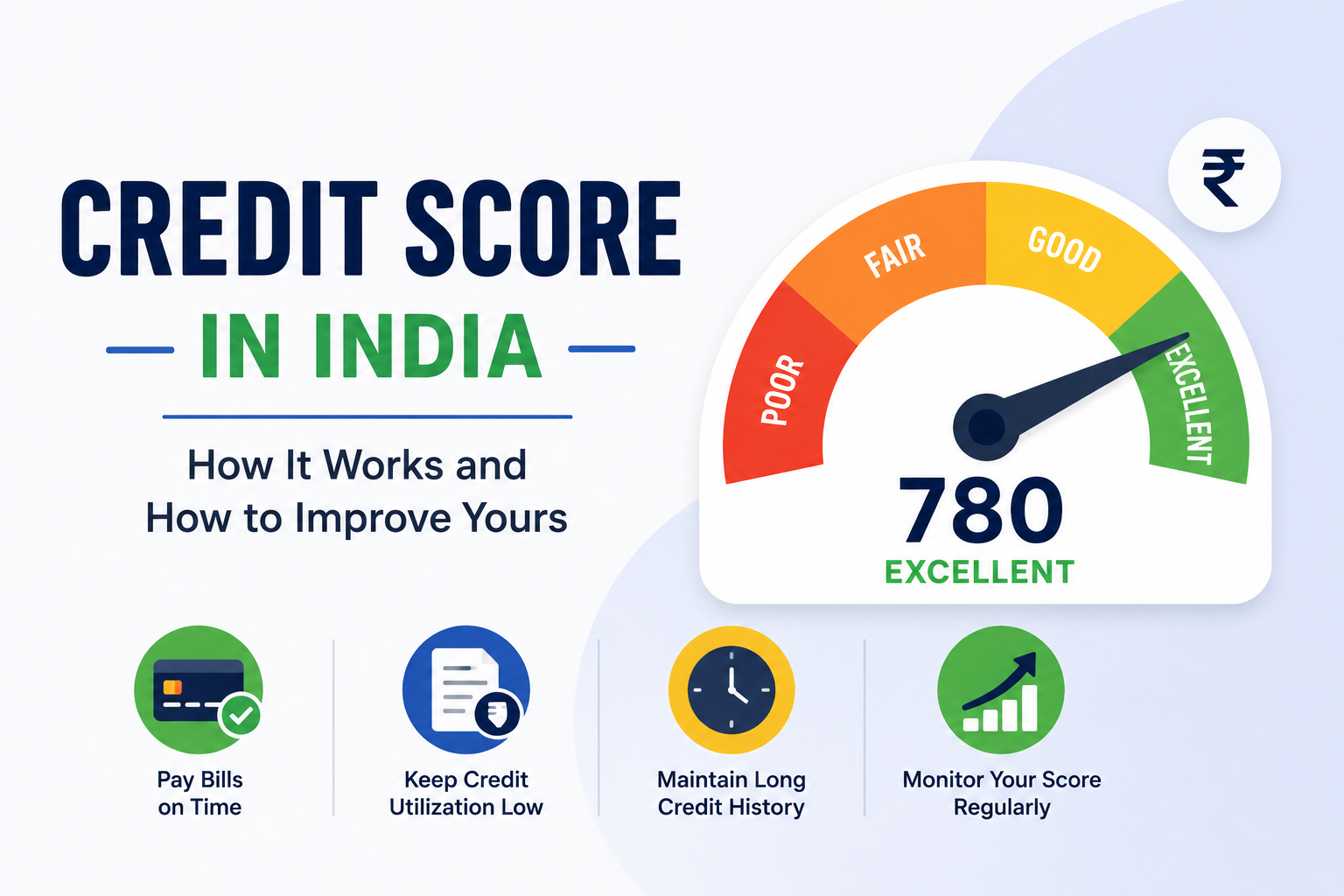
The scoring range runs from 300 to 900. Here is what each range means in practical terms:
| Score Range | Rating | What It Means |
|---|---|---|
| 750 to 900 | Excellent | Best loan rates, fast approvals, premium card eligibility |
| 700 to 749 | Good | Most loans approved, slightly higher rates than top tier |
| 650 to 699 | Fair | Loans possible but costlier, limited card options |
| 600 to 649 | Poor | Many lenders will reject, high interest rates if approved |
| 300 to 599 | Very Poor | Most applications rejected, limited options |
| -1 or 0 | No History | No credit activity on record — not bad, just new |
The target for most financial goals is 750 and above. At this level, you qualify for the best rates most lenders offer, approval is typically fast, and you have genuine negotiating power. Anything above 800 puts you in a position where lenders actively compete for your business.
A score of -1 or 0 simply means you have never borrowed money or used a credit card — you have no credit history, not a bad one. Building from zero takes time but is entirely straightforward.
How is Your Credit Score Calculated?
Your score is calculated using five main factors. Understanding each one tells you exactly which levers to pull when you want to improve.
Payment History — 35% of Your Score
This is the single most influential factor. Every EMI payment, credit card bill, and loan instalment you make on time strengthens this component. Every missed payment, delayed payment, or default damages it — and the damage lingers.
A single missed payment can drop your score by 50 to 100 points and stays on your credit report for years. Conversely, a consistent track record of on-time payments is the most reliable way to build a strong score over time.
Credit Utilisation — 30% of Your Score
Credit utilisation is the percentage of your available credit limit that you are currently using. If your credit card has a ₹1 lakh limit and your outstanding balance is ₹40,000 — your utilisation is 40 percent.
Lenders prefer to see utilisation below 30 percent. High utilisation signals financial stress — it suggests you are dependent on borrowed money to manage your monthly expenses, which makes you a higher risk borrower.
This is one of the fastest-moving factors in your score. Paying down your credit card balance can improve your utilisation — and your score — within a single billing cycle.
Length of Credit History — 15% of Your Score
How long you have been using credit matters. Older accounts with clean payment histories demonstrate consistent, reliable behaviour over time. A 10-year-old credit card with a perfect payment record contributes more positively to this factor than a brand new one.
This is why financial advisors consistently recommend keeping your oldest credit card account open even if you rarely use it — closing it shortens your average account age and can lower your score.
Credit Mix — 10% of Your Score
Having a healthy mix of credit types — secured loans like a home loan or car loan alongside unsecured credit like credit cards — signals to lenders that you can manage different kinds of financial obligations responsibly.
You do not need to take on debt purely for this factor — it is the lowest-weighted component. But if you only have credit cards and no loan history, adding an affordable secured loan over time does strengthen this component.
Recent Credit Enquiries — 10% of Your Score
Every time you apply for a new loan or credit card, the lender makes a “hard enquiry” on your credit report. A single hard enquiry causes a small, temporary dip in your score. Multiple hard enquiries within a short period — applying for five loans in two months, for example — signals financial desperation to lenders and can cause a more significant drop.
This is why you should never apply for multiple loans simultaneously when you are credit-hungry. Space applications out and apply only when you are genuinely ready.
What Damages Your Credit Score?
Understanding what hurts your score is just as important as knowing what helps it. Here are the most common score-damaging behaviours:
Missing EMI payments. Even one missed payment has a disproportionate negative effect. Set up auto-debit for every EMI and credit card minimum payment to eliminate this risk entirely.
Using too much of your credit limit. Consistently running high balances on your credit card — even if you pay in full each month — can temporarily spike your reported utilisation depending on when the lender reports your data to the bureau.
Closing old credit cards. It feels responsible but it is often counterproductive. Closing a card reduces your total available credit limit, which increases your utilisation percentage, and shortens your credit history.
Settling a loan for less than the full amount. A “settled” status on your credit report is significantly worse than a fully paid one. It tells lenders you could not meet your original obligation and negotiated a reduction. This mark can affect your score for years.
Multiple loan applications in a short time. Each application triggers a hard enquiry. Several enquiries in rapid succession look like financial distress regardless of your actual situation.
Being a guarantor for someone who defaults. If you have co-signed or guaranteed a loan for someone and they miss payments, those missed payments appear on your credit report too — as if they were your own.
How to Check Your Credit Score for Free
You are entitled to one free credit report per year from each of the four bureaus. Here is how to access yours:
CIBIL — Visit cibil.com and create an account. Free report once per year. Additional checks require a subscription.
Experian — Visit experian.in for your free annual report.
Free checking via apps — Several apps in India provide free CIBIL score checks with no annual limit — Paisabazaar, BankBazaar, OneScore, and CRED all offer free score checks. These use what is called a “soft enquiry” which does not affect your score in any way.
Check your score at least once every three months — not to obsess over small movements, but to catch errors or unexpected changes that might indicate fraud or incorrect reporting.
When you receive your credit report, go through every entry carefully. Errors are more common than most people expect — wrong loan balances, accounts you never opened, closed accounts still showing as active. Any error can be disputed formally with the bureau and corrected, sometimes adding 30 to 50 points once resolved.
How to Improve Your Credit Score — Step by Step
These steps are arranged in order of impact — start from the top and work down.
Step 1 — Check Your Report for Errors First
Before anything else, pull your full credit report and go through every line. Look for accounts you did not open, payments marked late that you paid on time, loans showing active that you have fully repaid, or incorrect personal information. Dispute every error directly with the bureau through their official dispute portal. Fixing a genuine error is the fastest possible score improvement — it can move your score significantly within 30 to 45 days.
Step 2 — Never Miss a Payment Again — Starting Today
Set up auto-debit for every EMI and at minimum the minimum payment on every credit card. Do this today — not next week. Payment history is 35 percent of your score. Every on-time payment strengthens it. Every missed payment damages it for years. Automation removes the human error factor entirely.
Step 3 — Pay Down Your Credit Card Balances
If your credit utilisation is above 30 percent, reducing it is the single fastest way to improve your score in the short term. Pay more than the minimum balance. If possible, pay the full outstanding balance each month. Even if you cannot eliminate the balance entirely, getting utilisation below 30 percent — and ideally below 10 percent — has a measurable, relatively quick impact on your score.
Step 4 — Request a Credit Limit Increase
If paying down your balance is not immediately possible, requesting a credit limit increase on your existing card achieves a similar mathematical result. If your limit goes from ₹50,000 to ₹80,000 and your balance stays the same, your utilisation percentage drops automatically. Most banks allow limit increase requests through their app or website. This is one of the easiest score improvements available to existing cardholders with a good payment history.
Step 5 — Do Not Close Old Accounts
Unless an account carries an annual fee you genuinely cannot justify, keep your oldest credit card accounts open and occasionally use them for a small purchase you immediately pay off. The account age they contribute to your profile is more valuable than the minor inconvenience of managing an extra card.
Step 6 — Add a Secured Credit Product if You Have No Loan History
If your credit mix is entirely credit cards with no loan history, consider a secured loan — a loan against a fixed deposit is the lowest-risk option. You deposit money, the bank gives you a loan against it, and you repay the EMIs on time. Your deposit earns interest, you build a loan repayment history, and your score improves. The net cost is minimal because your FD interest partially offsets the loan interest.
Step 7 — Space Out New Credit Applications
If you are planning to apply for a home loan or car loan in the next six to twelve months, stop applying for new credit cards or personal loans in the meantime. Each application creates a hard enquiry. Space any new applications by at least three to six months and only apply when you are serious about taking the credit.
Step 8 — Monitor Monthly and Stay Patient
Credit score improvement is not a two-week project. Meaningful improvement takes three to six months of consistent good behaviour. Reaching 750 from 650 typically takes six to twelve months. Reaching 800 from 750 can take another six to twelve months beyond that. The process is predictable and the results are durable — unlike quick fixes that promise overnight improvement and deliver nothing.
How Long Does It Take to Improve?
This question deserves an honest answer rather than an optimistic one.
If your score is low because of errors — disputed and corrected errors can improve your score within 30 to 45 days. That is the fastest genuine improvement available.
If your score is low because of high utilisation — paying down card balances takes effect within one to two billing cycles, typically 30 to 60 days.
If your score is low because of missed payments or defaults — this takes longer. Consistent on-time payment behaviour over six to twelve months is typically needed before significant improvement shows. The negative marks do not disappear quickly but their weight diminishes as more recent positive behaviour accumulates.
Building from zero credit history to a score above 700 typically takes twelve to eighteen months of consistent, responsible credit use.
The timeline is slower than most people want but faster than most people fear — and every month of good behaviour moves you in the right direction whether you see the movement immediately or not.
Credit Score Myths Indians Believe (That Are Wrong)
“Checking my own credit score hurts it.” Completely false. Checking your own score is a soft enquiry and has zero effect on your score. Only hard enquiries — from lenders when you apply for credit — cause a temporary dip. Check your score as often as you like.
“A higher income means a better score.” Your income is not reported to credit bureaus and has no direct impact on your score. A person earning ₹5 lakh per year with disciplined credit habits can have a better score than someone earning ₹50 lakh who misses payments.
“Closing unused credit cards improves my score.” Usually the opposite — as discussed earlier, closing cards reduces your available credit limit and shortens your credit history, both of which can lower your score.
“Paying the minimum amount due is enough.” Paying only the minimum keeps you out of default, but if it results in a high ongoing balance, your utilisation stays elevated and your score does not improve. Pay as much of the full balance as you can.
“I do not need a credit score if I have savings.” Savings are not visible to lenders. When you apply for a home loan, the bank does not look at your savings account balance first — they check your credit score. A high score and a low score are treated entirely differently regardless of how much money you have saved.
Final Thoughts
Your credit score is one of the most consequential numbers in your financial life — and most Indians pay almost no attention to it until the moment they need it and discover it is not where it should be.
The frustrating part about that timing is that credit score improvement cannot be rushed. It is built through months of consistent, undramatic behaviour — paying on time, keeping balances low, avoiding unnecessary new applications. None of that is exciting. All of it is effective.
Start by checking your score today — it is free and takes five minutes. If it is where you want it to be, maintain the habits that got you there. If it needs improvement, the steps in this guide give you a clear, actionable path forward.
Your score three years from now will be a direct reflection of the financial decisions you make starting today. That is not a threat — it is an opportunity.
Key Takeaway
Your credit score in India runs from 300 to 900 — aim for 750 and above for the best loan rates and approvals. The five factors that determine it are payment history (35%), credit utilisation (30%), length of credit history (15%), credit mix (10%), and recent enquiries (10%). The fastest improvements come from fixing report errors, reducing credit card utilisation, and never missing a payment again. Check your score free via Paisabazaar or OneScore. Improving from a poor score to a good one takes 6 to 12 months of consistent behaviour — there are no legitimate shortcuts, but the process is entirely within your control.