
A couple of years ago, most people had never used an AI assistant. Today, choosing between them has become a genuine decision — like picking a smartphone or a productivity app. You have options, they are meaningfully different, and the wrong choice can mean you are doing more work than necessary.
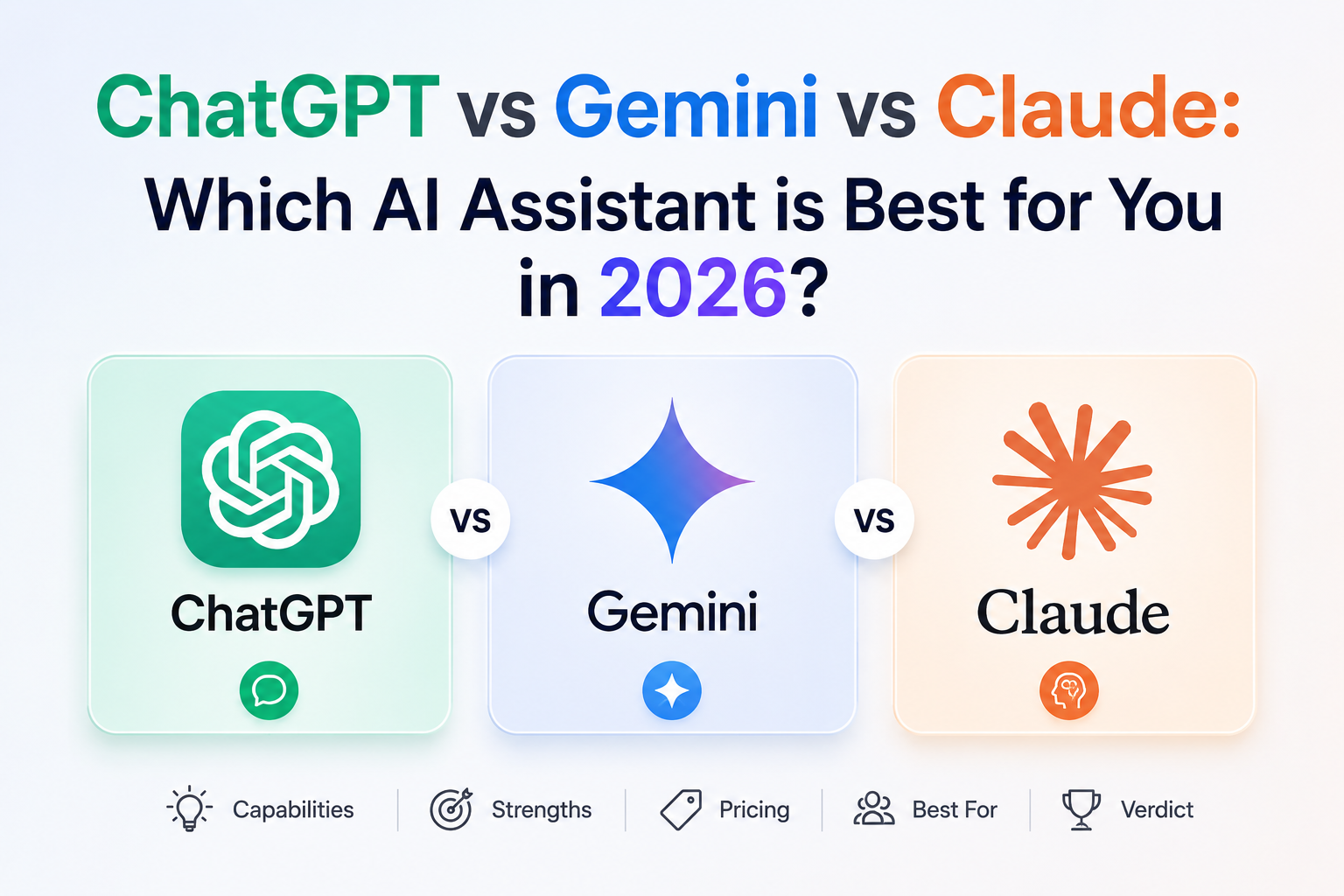
The three names that come up in almost every conversation about AI assistants in 2026 are ChatGPT, Google Gemini, and Claude. Each one is built by a different company, with a different philosophy, and they are genuinely good at different things.
This is not a post about which AI is “winning” technically. It is about which one is actually right for the way you work, what you use it for, and what matters most to you.
A Quick Introduction to Each AI
Before comparing, here is a one-paragraph understanding of each:
ChatGPT is made by OpenAI and was the AI that started the mainstream conversation. It is the most widely used AI assistant in the world, has the largest ecosystem of plugins and integrations, and in 2026 runs on the GPT-4o model. Most people’s first AI experience was with ChatGPT, and for good reason — it is capable, versatile, and has had longer to mature.
Google Gemini is Google’s AI assistant, deeply integrated with the tools most Indians already use every day — Gmail, Google Docs, Google Search, YouTube, and Google Drive. Gemini runs on Google’s own AI model and has a significant advantage: it can search the web in real time and pull current information, something that matters a great deal if your work involves staying updated.
Claude is made by Anthropic and has quietly become the favourite of writers, researchers, and professionals who need long, nuanced, thoughtful responses. Claude has the largest context window of the three — meaning it can read and analyse very long documents in a single conversation — and is widely regarded as the most careful and precise writer among the three.
ChatGPT vs Gemini vs Claude — Head to Head
Writing Quality
All three can write. The difference is in the character of the writing.
ChatGPT produces clean, structured content quickly. It follows instructions well and handles a wide variety of formats — emails, blog posts, social media captions, reports. The writing is competent and reliable, though experienced readers often notice a certain ChatGPT “flavour” — slightly formulaic, always balanced, occasionally generic.
Gemini writes clearly and is particularly good at short, practical content. It integrates naturally with Google Docs, which makes it genuinely useful for people who draft inside Google’s ecosystem. For quick summaries and factual writing it is solid, but for long-form nuanced content it trails the other two.
Claude consistently produces the most natural, human-sounding writing of the three. It handles tone variation well, avoids the robotic rhythm that makes AI writing detectable, and excels at longer pieces where sustained voice and coherence matter. If writing quality is your top priority, Claude has an edge.
Winner for writing: Claude, with ChatGPT a close second.
Research and Real-Time Information
This is where Gemini has a clear advantage.
Gemini is connected to Google Search and can pull current, real-time information from the web. Ask it about today’s stock prices, the latest news, recent product launches, or current events — and it can answer with up-to-date information pulled directly from live sources.
ChatGPT also offers web search in its paid tier, though the implementation is not as seamlessly integrated as Gemini’s.
Claude in its standard form does not browse the web by default, though web search is available as a feature. For research involving information that changes — market data, current affairs, new technology releases — Gemini is your most reliable choice.
If you are researching something that does not require real-time data — history, concepts, analysis, strategy, frameworks — all three perform comparably.
Winner for research: Gemini, especially for Indian users already inside Google’s ecosystem.
Handling Long Documents
This is Claude’s strongest suit and it is not particularly close.
If you need to paste an entire research paper, a long contract, a 50-page business report, or a full book chapter and ask questions about it — Claude handles this better than either alternative. It reads carefully, retains detail across the conversation, and synthesises complex material with clarity.
ChatGPT handles documents reasonably well but can lose detail in very long inputs. Gemini’s document handling has improved in 2026 but still trails Claude for complex, nuanced analysis of lengthy material.
For students, researchers, lawyers, consultants, or anyone regularly working with long-form documents — Claude’s context handling is a genuine differentiator.
Winner for long documents: Claude, clearly.
Coding Assistance
ChatGPT and Claude are both excellent coding assistants. ChatGPT has a longer track record with developers and a large community of people sharing prompts specifically for coding. It handles debugging, code explanation, and writing new functions across all major languages competently.
Claude has become increasingly popular with developers in 2026 for its ability to understand large codebases — paste an entire file and ask it to find bugs or suggest improvements, and it does so with impressive precision.
Gemini integrates directly with Google’s development tools and is useful for people working within that ecosystem, but for general coding assistance it sits behind the other two.
Winner for coding: Tie between ChatGPT and Claude — depends on your workflow.
Integration with Other Tools
ChatGPT wins this category because of its sheer ecosystem size. It connects with hundreds of third-party tools, has an API that developers use widely, and integrates with platforms ranging from Zapier to Slack to Notion.
Gemini wins specifically for Google Workspace users. If your team lives in Gmail, Google Docs, Google Sheets, and Google Meet — Gemini is embedded directly into those tools in a way that ChatGPT and Claude are not. For Indian professionals and small businesses heavily using Google’s free tools, this integration is genuinely valuable.
Winner for integrations: ChatGPT overall, Gemini for Google Workspace users.
Which AI is Best for Your Use Case?
Rather than picking one winner overall — because there genuinely is not one — here is a practical guide based on what you actually do:
You should use ChatGPT if: You need a versatile all-rounder, work across many different tasks, need plugin and third-party integrations, or are a developer who wants a mature, well-documented AI tool.
You should use Gemini if: You live inside Google Workspace, need real-time web information regularly, want AI built into Gmail and Docs without switching apps, or are a student or professional who relies on Google’s ecosystem daily.
You should use Claude if: You write long-form content, work with lengthy documents or reports, want the most natural and nuanced writing output, or need an AI that handles complex, multi-step analysis carefully and patiently.
And honestly — many professionals in 2026 use more than one. Gemini for quick web research, Claude for writing and document work, ChatGPT for coding and integrations. The tools are cheap enough that using two or three together is more practical than it sounds.
Pricing in India — What You Actually Pay
| AI | Free Plan | Paid Plan | Cost (approx.) |
|---|---|---|---|
| ChatGPT | Yes — GPT-4o limited | ChatGPT Plus | ₹1,650/month |
| Google Gemini | Yes — Gemini 1.5 Flash | Gemini Advanced | ₹1,950/month |
| Claude | Yes — Claude Sonnet limited | Claude Pro | ₹1,700/month |
All three have usable free tiers. For casual users who need an AI a few times a week, the free versions are sufficient. For daily professional use — especially if you need the most capable models — the paid plans are worth the cost. At roughly ₹1,700 per month, any of these pays for itself if it saves you even two hours of work.
Honest Limitations of Each
No AI assistant is perfect, and knowing the limitations matters as much as knowing the strengths.
ChatGPT can be overconfident — it sometimes presents incorrect information with the same tone as correct information. Always verify factual claims, especially numbers and dates.
Gemini occasionally struggles with complex multi-step reasoning and can feel less nuanced in its responses compared to the other two. Its writing for long-form content can feel slightly mechanical.
Claude is more cautious by design — it will sometimes decline to help with things the other two assist with freely, and it can be verbose where brevity would serve better. Its web browsing is less seamlessly integrated than Gemini’s.
None of them replace human judgement, professional expertise, or original thinking. They are tools — powerful ones — but the quality of what you get out depends heavily on the quality of what you put in.
Final Thoughts
Choosing between ChatGPT, Gemini, and Claude in 2026 is less about which one is objectively best and more about which one fits your specific workflow.
If you have never used an AI assistant seriously, start with the free version of any of these three for two weeks and pay attention to where it helps and where it falls short. That experience will tell you far more than any comparison article — including this one.
What is clear is that ignoring these tools entirely is increasingly costly. The people using them well are getting real advantages in how much they can produce, how quickly they can research, and how much mental energy they preserve for the work that actually requires human thinking.
Pick one. Start today. Adjust from there.
Key Takeaway
In 2026, ChatGPT is the best all-rounder with the largest ecosystem, Gemini is the best choice for Google Workspace users and real-time research, and Claude produces the most natural writing and handles long documents best. Most professionals benefit from using two of the three together rather than picking just one. All have free tiers — try before you commit to a paid plan.