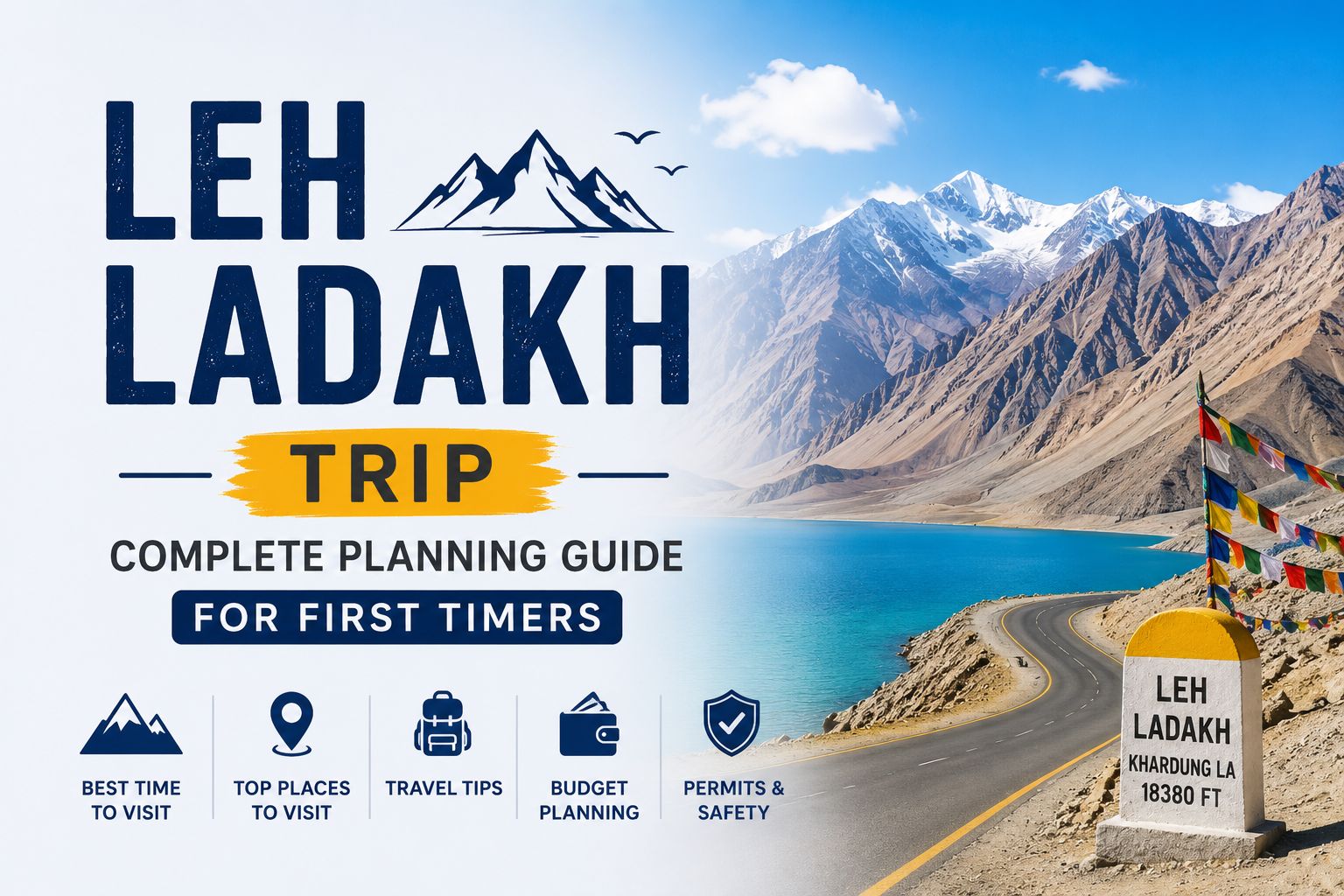

There are places you visit and places that change you. Leh Ladakh is firmly in the second category.
Most people who have been to Ladakh will tell you the same thing — nothing quite prepares you for it. Not the photographs, not the travel videos, not the stories from friends who went before you. The scale of the landscape, the quality of the silence, the strangeness of standing at 17,000 feet on a road that should not exist — these things need to be experienced in person to mean anything.
But Ladakh is also a destination that rewards good planning and punishes bad planning in equal measure. The altitude is real. The road conditions are challenging. The remoteness means mistakes are harder to fix than anywhere else in India. First-timers who go without understanding what they are getting into either spend half their trip dealing with altitude sickness, or miss experiences they could have had with better preparation.
This guide gives you everything you need — when to go, how to get there, what permits you need, how to acclimatise properly, a realistic itinerary, what to budget, and the specific things that experienced Ladakh travellers wish someone had told them before their first trip.
Why Ladakh is Unlike Anywhere Else in India
Ladakh sits in the northernmost part of India, sandwiched between the Great Himalayas and the Karakoram range. It is a high-altitude cold desert — meaning it gets very little rainfall, the air is dry and thin, and the landscape looks nothing like the green hills most Indians associate with mountain travel.
Dry mountains, blue skies, ancient monasteries, high-altitude passes, peaceful villages and dramatic landscapes make it a dream destination for nature lovers, bikers, photographers, trekkers and adventure seekers.
What makes Ladakh genuinely different from every other destination in India is the combination of altitude, remoteness, and cultural richness. Buddhist monasteries perched on cliffsides. Villages that feel untouched by time. Lakes at 14,000 feet that are a shade of blue you have never seen before. Roads that cross passes higher than most European mountains. And a pace of life that is so different from urban India that even a week there produces a disorientation that takes days to shake after returning home.
It is also one of the most physically demanding tourist destinations in India. The altitude affects everyone differently — even fit, healthy people can experience headaches, breathlessness, and fatigue for the first two days. Ignoring acclimatisation is the single biggest mistake first-time visitors make, and we will cover it in detail.
Best Time to Visit — Season by Season
First-time visitors usually prefer travelling between May and September because the weather is easier and most routes remain accessible.
Here is what each season actually means in practice:
May to June — Early Summer
Roads begin opening after winter — the Manali-Leh Highway typically opens in late May, the Srinagar-Leh Highway in early April. Temperatures are pleasant during the day (15°C to 25°C in Leh town) and cold at night (5°C to 10°C). Fewer tourists than peak season. Some high passes may still have snow which makes the drive even more dramatic. This is genuinely one of the best windows to visit — before the main tourist rush but after the worst of the winter closures.
July to August — Peak Season
Ladakh continues to attract travelers looking for slow, meaningful journeys rather than rushed sightseeing in 2026. July and August are the busiest months. All routes are open, all attractions are accessible, and the weather is at its most stable. The flip side is that accommodation books out weeks in advance in popular areas like Pangong Lake, prices are at their highest, and Leh town can feel surprisingly crowded. If you visit during this window, book everything at least four to six weeks ahead.
September to mid-October — Late Summer
The crowds thin significantly after the first week of September. Weather remains pleasant, all passes are still open, and accommodation is easier to find at better prices. September is arguably the best month for first-timers — good weather, less crowd, beautiful golden light as autumn approaches. This is the window experienced Ladakh travellers often recommend.
November to March — Winter
Both major highways connecting Ladakh to the rest of India — the Manali-Leh Highway and the Srinagar-Leh Highway — remain closed by December because snow at high passes makes driving unsafe. These roads reopen only around late April or early May. Therefore, during winter the only way to reach Leh is by flight.
Winter Ladakh is extraordinary but not for first-timers. Temperatures drop to -15°C to -25°C in January. The famous Chadar Trek — walking across the frozen Zanskar River — is one of India’s most challenging and spectacular adventures, but it requires serious physical preparation and an experienced guide.
The honest recommendation for first-timers: September. Weather is excellent, crowds are manageable, prices are reasonable, and all the major attractions are accessible.
How to Reach Leh — By Air vs By Road
By Air — Fastest and Easiest
Fly into Leh Airport (Kushok Bakula Rimpochee Airport) from Delhi, Mumbai, or Bangalore. It is the most convenient option for first-timers.
The flight from Delhi to Leh takes approximately one hour. It is one of India’s most scenic flights — on clear days you can see the Himalayan range from the aircraft window before landing in a high-altitude valley surrounded by bare mountains. Book early — Leh flights sell out quickly during peak season and prices spike significantly with last-minute bookings.
The important caveat with flying is altitude adjustment. You go from near sea level to 3,500 metres in one hour. Your body has had zero time to adjust. This is why the first two days after flying in must be spent acclimatising in Leh — not rushing off to Pangong Lake.
By Road via Manali-Leh Highway
The Manali-Leh Highway is one of the world’s great road journeys — approximately 490 km crossing five high mountain passes including the Baralacha La (4,890 metres) and Tanglang La (5,328 metres). The drive takes two days with an overnight stop at Sarchu or Jispa.
The road journey provides natural acclimatisation because you gain altitude gradually over two days rather than in one hour. By the time you arrive in Leh you are already partially adjusted. This makes the road journey genuinely preferable from a health perspective despite being significantly longer.
By road via Srinagar offers a gradual ascent route, better for acclimatisation and a smoother journey. The Srinagar-Leh Highway covers approximately 434 km and passes through the Zoji La pass and the beautiful Sonamarg valley. It is a gentler road than the Manali route and offers different landscapes — greener valleys before transitioning to the stark Ladakhi terrain.
Which to choose: If your time is limited, fly in. If you have 10 or more days and want the road experience, take the Manali-Leh Highway one way and fly the other — this is the most popular combination.
The Single Most Important Thing — Acclimatisation
Read this section carefully. More first-time Ladakh trips are ruined by ignoring acclimatisation than by any other factor.
Leh sits at approximately 3,524 metres above sea level. Pangong Lake is at 4,350 metres. Khardung La pass is at approximately 5,359 metres. At these altitudes, the air contains significantly less oxygen than at sea level. Your body needs time to adjust — to produce more red blood cells, to breathe more efficiently, to manage the reduced oxygen availability.
Acute Mountain Sickness (AMS) is a real medical condition that affects people at altitude regardless of age, fitness, or previous mountain experience. Symptoms include severe headache, nausea, dizziness, fatigue, and in serious cases difficulty breathing. Ignoring early symptoms and continuing to higher altitudes can escalate into life-threatening conditions.
The acclimatisation protocol for Ladakh is simple and non-negotiable:
Day 1 after arriving in Leh — rest completely. Do not trek. Do not do any strenuous activity. Walk slowly. Drink at least three to four litres of water. Eat light meals. Sleep as much as possible. The headache you experience on day one is normal — it is your body adjusting. Paracetamol helps with the headache. Do not take pain medication to mask symptoms and push yourself harder.
Day 2 — gentle acclimatisation walks. Visit places within Leh town — Shanti Stupa, Leh Palace, the local market. Walk slowly. Rest frequently. Continue drinking large amounts of water. Avoid alcohol entirely for the first two days — it dehydrates you and significantly worsens altitude sickness.
Day 3 onwards — if you feel well and have no significant symptoms, you can begin exploring further afield. Do not go straight from Leh to Pangong Lake or Khardung La on day three. Add altitude gradually.
Diamox (acetazolamide) is a medication that helps with altitude acclimatisation. Consult your doctor before the trip and carry it as a precaution — many experienced Ladakh travellers take it preventively from a day before arrival.
Permits You Need and How to Get Them
Indian nationals require an Inner Line Permit (ILP) to visit several areas in Ladakh. The permit is straightforward to obtain but skipping it means you will be turned back at checkpoints.
Areas requiring ILP for Indian nationals:
- Nubra Valley
- Pangong Lake
- Tso Moriri
- Dah-Hanu (Aryan Valley)
Indian travelers need an Inner Line Permit (ILP) for areas like Nubra Valley and Pangong Lake. Foreign nationals require a Protected Area Permit (PAP). Permits can be applied online or obtained in Leh.
How to get it: Apply online at the Ladakh Tourism website before your trip, or obtain it in person at the Deputy Commissioner’s office in Leh. In-person processing takes two to four hours. Online processing is faster and recommended. The permit costs approximately ₹100 to ₹200 per person depending on the area and is valid for the specific dates you mention in the application.
Carry multiple photocopies of your permit, ID proof, and passport-size photographs — checkpoints will collect copies and you need originals at each point.
7-Day First Timer Itinerary
This itinerary is designed around proper acclimatisation while covering Ladakh’s most iconic experiences.
Day 1 — Arrive Leh, Rest Completely
Land in Leh, check into your hotel, drink water, rest. Do not plan anything for day one. Your body needs this day more than any activity does. A short, slow walk to the local market in the evening is fine — nothing more.
Day 2 — Leh Town Acclimatisation
Shanti Stupa in the morning for a gentle walk and panoramic views of Leh valley. Leh Palace in the afternoon — the former royal palace offers excellent views and interesting history. The main market bazaar for local handicrafts and dried apricots in the evening. Stay well hydrated throughout.
Day 3 — Monasteries Day Trip
Monasteries such as Thiksey, Shey, and Hemis welcome visitors. These three monasteries are within 40 km of Leh and make for an excellent day trip. Thiksey Monastery — often compared to the Potala Palace in Tibet — is the most visually striking. Hemis is the largest and richest monastery in Ladakh. Shey Palace adds historical depth. Hire a local taxi for the day — approximately ₹1,500 to ₹2,000.
Day 4 — Nubra Valley via Khardung La
Cross the famous Khardung La pass — one of the world’s highest motorable roads at approximately 5,359 metres — and descend into the lush Nubra Valley. Visit Diskit Monastery and the massive Maitreya Buddha statue. Evening at the Hunder sand dunes — yes, sand dunes in the middle of a mountain valley — with the option of a Bactrian (double-humped) camel ride. Overnight in Nubra Valley.
Day 5 — Nubra to Pangong Lake
Drive from Nubra Valley to Pangong Lake via the scenic Shyok Valley route — approximately four to five hours. Arrive at Pangong Tso in the afternoon when the light is best for the famous blue-blue-blue colour the lake is known for. Overnight camping or guesthouse stay at the lakeside — one of the most memorable nights you will spend anywhere in India.
Day 6 — Pangong Lake to Leh
Spend the early morning at the lake before the day-trippers arrive from Leh — the morning light is extraordinary. Drive back to Leh via Chang La pass. Rest afternoon in Leh.
Day 7 — Magnetic Hill, Confluence, Departure
Morning visit to the Sangam — the confluence of the Indus and Zanskar rivers — one of Ladakh’s most photogenic spots. Magnetic Hill (the road that appears to slope downward but cars seem to roll uphill — a fascinating optical illusion). Gurudwara Pathar Sahib. Afternoon flight back to Delhi or overnight Manali drive begins.
Places You Must See in Ladakh
Pangong Tso — The iconic high-altitude lake stretching from India into Tibet. Most travellers include Pangong in their Leh Ladakh tour package or road trip itinerary. The colour of the water changes through shades of blue and green through the day in a way that photographs cannot fully capture.
Nubra Valley — A fertile river valley with sand dunes, double-humped camels, apricot orchards, and a dramatically different landscape from the rest of Ladakh. The drive over Khardung La to get there is an experience in itself.
Tso Moriri — Tso Moriri is quieter than Pangong and ideal for travellers who want a peaceful high-altitude lake experience. Less visited, arguably more beautiful, and the drive there passes through some of Ladakh’s most remote and stunning terrain. Typically added to longer itineraries of 9 to 10 days.
Zanskar Valley — Zanskar Valley is perfect for trekkers and adventure lovers. It is known for remote villages, dramatic landscapes, monasteries and winter treks. The Chadar Trek, where travellers walk over the frozen Zanskar River, is one of India’s most challenging winter adventures.
Hemis National Park — Hemis National Park is one of the best places in India to spot the elusive snow leopard. It is also home to Himalayan wildlife such as ibex, Tibetan wolf, blue sheep and other high-altitude species.
Shanti Stupa — A white-domed Buddhist stupa on a hilltop overlooking Leh town. The 360-degree view at sunset is one of Ladakh’s most beautiful moments and requires only a 15-minute walk.
Where to Stay — Budget to Mid-Range
In Leh Town
Guesthouses in Leh town range from ₹700 to ₹1,500 per night for a clean, basic room with meals available. Mid-range hotels with attached bathrooms and reliable hot water cost ₹2,000 to ₹4,000 per night. Book in advance for July and August — Leh fills up completely during peak season.
At Pangong Lake
Lakeside tent camps and basic guesthouses are the primary options. Tent camp accommodation costs ₹1,500 to ₹3,000 per night including dinner and breakfast — meals are essentially mandatory at the lake since there are very few independent restaurants. The experience of sleeping metres from the lake in complete silence more than justifies the cost.
In Nubra Valley
Guesthouses and small camps in Hunder and Diskit cost ₹1,000 to ₹2,500 per night. Staying overnight in Nubra is strongly recommended — driving over Khardung La twice in one day is exhausting and means you miss the beautiful morning light in the valley.
What to Pack — The Non-Negotiables
Ladakh requires specific preparation that differs from packing for a regular hill station trip. Do not underestimate this section.
Warm layers even in summer. Daytime temperatures in June to August can reach 25°C to 30°C in Leh but drop to 5°C to 10°C at night. At Pangong Lake and in Nubra, nights are colder. Thermal innerwear, a fleece layer, and a good windproof jacket are non-negotiable even in the height of summer.
Sunscreen and UV protection. At high altitude, UV radiation is significantly stronger than at sea level. Sunburn in Ladakh happens faster and more severely than anywhere else in India. SPF 50+ sunscreen, good quality sunglasses, and a hat or scarf are essential.
Altitude sickness medication. Carry Diamox (consult your doctor beforehand), paracetamol for headaches, and an oral rehydration solution. Do not rely on being able to buy these in remote areas.
Cash in sufficient quantity. Always carry cash — ATMs are limited in Ladakh. Leh town has functional ATMs but they run out of cash during peak season. Remote areas like Pangong Lake and Nubra Valley have no ATMs. Carry enough cash for your entire stay beyond Leh before leaving the town.
Offline maps. Download the entire Ladakh region on Google Maps or Maps.me before you travel. Coverage is limited in remote areas though Leh town has 3G/4G. Offline maps are recommended for navigation.
Power bank. Cold temperatures drain phone batteries faster than normal. A high-capacity power bank is genuinely useful especially when camping or staying in basic guesthouses with limited charging points.
Personal medications and a basic first aid kit. Medical facilities outside Leh town are minimal. A basic kit with antiseptic, bandages, antihistamine, and your personal prescription medications is essential.
Budget Breakdown — What a Ladakh Trip Actually Costs
This covers a 7-day trip for one person flying from Delhi:
| Expense | Budget Option | Mid-Range |
|---|---|---|
| Flights (return Delhi-Leh) | ₹8,000 | ₹14,000 |
| Accommodation (7 nights) | ₹7,000 | ₹18,000 |
| Food (7 days) | ₹4,000 | ₹8,000 |
| Local transport (taxi hire) | ₹8,000 | ₹14,000 |
| Permits | ₹500 | ₹500 |
| Activities and entry fees | ₹1,500 | ₹3,000 |
| Miscellaneous (medicines, gear) | ₹2,000 | ₹3,000 |
| Total | ₹31,000 | ₹60,500 |
A solo budget traveller sharing taxis and staying in dorms or basic guesthouses can do a 7-day Ladakh trip for approximately ₹25,000 to ₹35,000. A couple in mid-range accommodation with a private hired vehicle should budget ₹50,000 to ₹70,000 combined.
Note that taxi hire in Ladakh works differently from other destinations — there is a union-regulated fixed tariff for most routes. You will not be able to negotiate dramatically below the official rates. Sharing taxis with other travellers is the most effective way to reduce transport costs.
Things Nobody Tells You Before Your First Trip
Your fitness level does not protect you from altitude sickness. Seasoned runners, gym regulars, and people who trek regularly in other parts of India all get altitude sickness in Ladakh. The altitude does not care about your fitness. Acclimatise regardless of how strong you feel.
Petrol stations are few and far apart. On the Manali-Leh Highway especially, fill up at every opportunity. Running low on petrol in a remote mountain stretch with no coverage and no station for 80 km is a genuinely serious problem.
Respect the environment. Ladakh is a fragile high-altitude ecosystem. Plastic waste is a serious and growing problem in the region. Carry a reusable water bottle, refuse single-use plastic wherever possible, and carry your waste back to Leh for disposal. The landscape that makes Ladakh extraordinary depends on every visitor treating it with care.
ATMs in Leh run out during peak season. Withdraw from Delhi or Chandigarh before reaching Leh. Carry more cash than you think you need. Being stranded at Pangong Lake with an empty wallet is an entirely avoidable problem.
The road conditions change daily. Mountain roads can be closed by landslides, snowfall, or army convoys with very little warning. Build flexibility into your itinerary — if a road closes and you cannot reach Pangong on day five, you need a day six that can absorb that change. Rigid day-to-day planning creates unnecessary stress in a region where flexibility is part of the experience.
Slow internet is a feature, not a bug. Mobile coverage in Leh town is functional but weak. Outside Leh it is patchy to nonexistent. Most visitors initially find this frustrating and then, by day three, deeply therapeutic. Let the disconnection happen. You came to Ladakh for a reason.
Final Thoughts
Ladakh is not a trip you tick off a bucket list and move on from. People who go once almost always want to go back — to the parts they missed, to the places they did not have time for, to experience a different season. It gets under your skin in a way that is difficult to articulate until you have been there.
The planning feels like a lot before you go. The permits, the altitude, the logistics, the gear — it adds up to a preparation effort that no other Indian destination requires. But once you are standing at Khardung La watching clouds move through a mountain range that stretches to the horizon in every direction, or sitting at the edge of Pangong Lake at dawn when the water is completely still and reflects the sky like a mirror — none of that preparation effort feels like anything at all.
Go prepared. Acclimatise properly. Carry cash. Move slowly. Let the place change pace for you rather than trying to cover everything.
Ladakh will do the rest.
Key Takeaway
Leh Ladakh is best visited between May and September for first-timers, with September being the ideal month — good weather, fewer crowds, and all routes open. Fly into Leh or drive the Manali-Leh Highway for natural acclimatisation. Spend the first two days resting in Leh before heading to higher altitudes — this is non-negotiable. Get your Inner Line Permit before leaving Leh for Nubra Valley or Pangong Lake. Carry sufficient cash, download offline maps, pack warm layers even in summer, and build flexibility into your itinerary. Budget ₹30,000 to ₹60,000 for a solo 7-day trip from Delhi. And above everything — go slowly. Ladakh rewards patience in a way few destinations in the world do.