
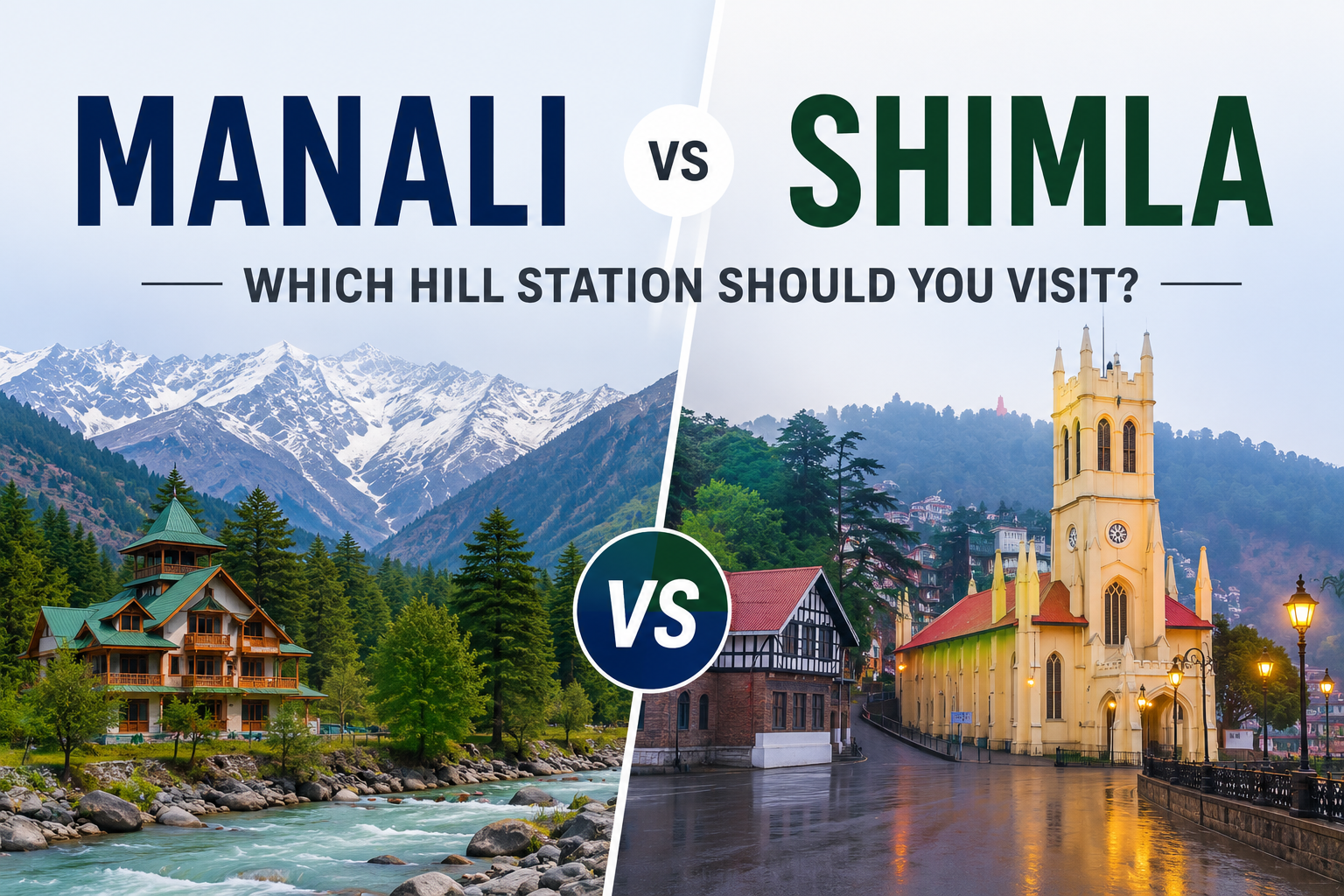

Every year, millions of Indians planning a Himachal Pradesh trip land on the same question — Manali or Shimla?
Both are iconic. Both are beautiful. Both offer mountain air, pine forests, and a proper escape from the heat of the plains. And yet they are genuinely very different places — different atmospheres, different activities, different types of travellers, and different trip experiences.
The honest answer to which is better is this: it depends entirely on you. Not in a vague, non-committal way — but specifically on your travel style, who you are going with, how much time you have, and what you actually want from a hill station trip.
This guide breaks down every important dimension of the comparison so that by the end you know exactly which one to book — and why.
Shimla and Manali at a Glance
Before the detailed comparison, here is a quick snapshot of both destinations:
Shimla — The capital of Himachal Pradesh, known as the Queen of Hills. Sits at approximately 2,200 metres above sea level. Famous for its colonial-era architecture, the Mall Road promenade, the historic Kalka-Shimla toy train, and a generally relaxed, accessible atmosphere. Shimla was the summer capital of British India, and that heritage is visible everywhere — in the buildings, the churches, the layout of the town.
Manali — A mountain town in the Kullu Valley, sitting at approximately 2,050 metres but surrounded by peaks that go significantly higher. Famous for Solang Valley, Rohtang Pass, the Beas River, river rafting, trekking, snow activities, and its position as the gateway to Spiti Valley and Leh-Ladakh. Manali has a more adventurous, rawer energy than Shimla.
The simplest way to think about it: Shimla is a hill station you stroll around. Manali is a mountain town you explore.
Weather and Best Time to Visit
Shimla
Shimla has a more moderate climate than Manali. Summers from March to June are pleasant with temperatures ranging between 15°C and 30°C — this is considered peak season. Winters bring occasional snowfall with temperatures ranging from -2°C to 10°C — cold but manageable for most visitors.
Shimla is best visited from March to June for pleasant weather and sightseeing, and December to February for snow lovers and honeymooners. Monsoon months — July to September — are the least ideal due to the risk of landslides and slippery mountain roads.
Manali
Manali’s tourist peak season also falls between March and June where temperatures range from 10°C to 25°C. Monsoon from July to September sees heavy rains that can hinder travel plans with a higher risk of landslides. Manali experiences colder winters with heavy snowfall especially from December to February with average temperatures of -7°C to 10°C — this time is excellent for snow sports and winter activities but may face accessibility issues due to snow.
The practical takeaway: Shimla has a milder, more forgiving climate year-round. Manali is more dramatic — which makes it more rewarding in the right season and more challenging in the wrong one. For a first hill station trip or travel with elderly family members or young children, Shimla’s more accessible weather is genuinely relevant.
How to Reach — Distance and Travel Time
To Shimla from Major Cities
From Delhi — approximately 350 km, 7 to 9 hours by road. Direct Volvo buses available from ISBT Kashmere Gate. The famous Kalka-Shimla toy train from Kalka (which connects to Delhi by train) is one of India’s most scenic rail journeys and a UNESCO World Heritage route — worth taking at least one way if time allows.
From Chandigarh — approximately 115 km, 3 to 4 hours. The closest major city to Shimla, making it an easy addition to a Chandigarh trip.
To Manali from Major Cities
From Delhi — approximately 540 km, 12 to 14 hours by road. Overnight Volvo buses from Delhi’s ISBT are the standard option and depart daily. No train directly to Manali — the nearest railhead is Ambala or Chandigarh.
From Chandigarh — approximately 310 km, 7 to 9 hours.
Shimla is comparatively closer than Delhi and Chandigarh. The roads are broad and in good condition, making it less tiring than the trip to Manali. Incredibly, day trips can be made to Kufri and Chail from Shimla.
Verdict on accessibility: Shimla wins this comparison clearly. It is closer, faster to reach, has better road quality, and the toy train option adds a genuinely special travel experience. Manali requires more commitment — a longer journey and more planning — but rewards that commitment with a more dramatic destination.
Things to Do — Activities and Attractions
Shimla
The Mall Road is the heart of Shimla — a pedestrian promenade lined with colonial buildings, cafes, shops, and mountain views. It is the kind of place you walk slowly, stop for chai, watch the town go about its day. Deeply pleasant rather than thrilling.
Beyond Mall Road, Shimla offers the Ridge (a large open space with panoramic Himalayan views), the Jakhu Temple (reached by a short but steep hike, with memorable encounters with Shimla’s resident monkeys), Kufri (a small hill station nearby with pony rides and basic snow activities in winter), Christ Church (one of North India’s finest colonial churches), and the Kalka-Shimla toy train experience.
Shimla is a destination for walking, exploring, eating, and absorbing atmosphere. It does not demand physical exertion and it does not need to — the charm is in the place itself.
Manali
Manali’s activity list reads differently. Major scenic attractions include Solang Valley, Rohtang Pass, and the Hadimba Temple. Beyond these, Manali offers river rafting on the fast-flowing Beas River, trekking routes ranging from day hikes to multi-day expeditions, paragliding, zorbing, snow activities at Solang Valley in winter, mountain biking, and camping.
For travellers continuing beyond Manali — if you are interested in visiting Spiti Valley or Leh, Manali will be your best point of departure. Manali is the starting point for the legendary Manali-Leh Highway, one of the world’s highest motorable roads, opening the door to Ladakh, Spiti, and some of India’s most extraordinary landscapes.
The Hadimba Temple — a wooden temple set in a forest of deodar cedars — is one of the most beautiful temple settings in India and genuinely worth visiting even if you are not religiously inclined. The forest surrounding it is stunning.
Verdict on activities: Manali wins for adventurous travellers. Shimla wins for those who want to relax, walk, and absorb a place without an itinerary full of activities. Both offer enough to fill three to five days comfortably.
Atmosphere and Vibe
This is where the two destinations diverge most clearly.
Shimla feels like a town. It has a functioning city centre, government offices, local markets, schools, and a community beyond tourism. The Mall Road has been there for over a century. There is history and permanence in Shimla that gives it a settled, distinctive character. Shimla is best for families, first-timers, and heritage lovers — offering easy accessibility, colonial charm, and comfortable stays.
Manali feels more like a base camp for adventure. The town itself — particularly Old Manali and the cafe street — has a free-spirited, backpacker energy with a strong presence of travellers, trekkers, and people heading further into the mountains. Manali is for people who have a restless spirit — for people who would like to hear a river’s roar from their balcony or wake up to mountain-capped snow.
If you want a town to wander through comfortably with good food and colonial charm — Shimla. If you want to feel like you are at the edge of something wilder and bigger — Manali.
Budget Comparison — Which Is More Affordable?
Both destinations can be done on a budget or spent lavishly — the range is wide in both places. But there are real differences.
Shimla is slightly more affordable on average. Accommodation in Shimla offers good options from ₹700 per night guesthouses to mid-range hotels at ₹2,000 to ₹3,500. Food on Mall Road is touristy and priced accordingly but local restaurants near the bus stand and lower bazaar are genuinely affordable.
Manali has a broader price range. Budget guesthouses in Old Manali and around Vashisht village cost ₹600 to ₹1,200 per night. The popular cafe strip in Old Manali caters to backpackers with affordable food. However adventure activities — Rohtang Pass permits and transport, snow activities, rafting, paragliding — add up quickly and are a significant additional expense that Shimla does not have.
| Expense | Shimla (4 days) | Manali (4 days) |
|---|---|---|
| Transport from Delhi (return) | ₹1,400 (bus) | ₹2,000 (bus) |
| Accommodation (4 nights) | ₹3,200 | ₹3,600 |
| Food (4 days) | ₹2,400 | ₹2,800 |
| Local transport & sightseeing | ₹1,200 | ₹1,800 |
| Activities | ₹800 | ₹2,500 |
| Total per person | ₹9,000 | ₹12,700 |
Shimla is more affordable for a comparable length trip — primarily because Manali’s activities add a meaningful cost that has no real equivalent in Shimla.
Which Is Better For… (Different Traveller Types)
Families with young children or elderly parents: Shimla. More accessible, easier roads, milder weather, lower altitude concerns.
Couples on a romantic trip: Manali is more popular for honeymoons because of its scenic beauty and romantic stays. The dramatic mountain scenery, the Beas River, cosy cafe culture — Manali has a natural romanticism. Shimla is also lovely for couples but feels more like a town break than a mountain escape.
Solo adventurous travellers: Manali clearly. The trekking, the route to Spiti and Leh, the backpacker community in Old Manali — Manali is built for this type of traveller.
First-time hill station visitors: If you are making your first trip to the Himalayas and wish to have an uneventful trip, begin from Shimla. Shimla’s accessibility, clear attractions, and forgiving weather make it a comfortable first Himalayan experience.
Friend groups looking for adventure: Manali. Rafting, paragliding, trekking, snow activities — the activity list is stronger and the vibe among travellers is more social and energetic.
Short trips (2 to 3 days): Shimla is better suited for 2 to 3 day trips due to its proximity and ease of travel. Getting to Manali and back in under three days from Delhi or Pune means most of your trip is spent in transit.
Can You Visit Both in One Trip?
Yes — and many travellers do exactly this. Many travellers combine both destinations through a Shimla-Manali tour package from Delhi.
A practical combined itinerary for 7 to 8 days from Delhi:
- Day 1: Delhi to Shimla (overnight bus or morning drive)
- Days 2 to 3: Explore Shimla — Mall Road, Jakhu Temple, Kufri
- Day 4: Shimla to Manali (6 to 7 hour drive through Kullu Valley — scenic route)
- Days 5 to 6: Explore Manali — Solang Valley, Hadimba Temple, Old Manali, Beas River
- Day 7: Manali to Delhi (overnight bus)
This gives you two to three days in each place — enough to experience the character of both without rushing. The Shimla to Manali road passes through the Kullu Valley and is one of Himachal Pradesh’s most beautiful drives, making the journey itself part of the experience.
Final Verdict
For 2026, choose Shimla for comfort and culture, Manali for adventure and altitude.
If you have never been to either — start with Shimla. It is easier to reach, gentler on first-time mountain visitors, historically rich, and gives you a genuinely beautiful hill station experience without the logistical complexity of Manali.
If you have done Shimla and want more — go to Manali. The dramatic landscapes, the adventure activities, and the gateway it provides to India’s most extraordinary high-altitude regions make it one of the most rewarding travel experiences in the country.
And if you have a week and the budget — do both. You will not regret it.
Key Takeaway
Shimla is the better choice for families, first-timers, short trips, and travellers who want a comfortable, culturally rich hill station experience. Manali is better for adventurous travellers, couples on a romantic trip, and anyone wanting snow activities, trekking, or the gateway to Spiti and Leh. Both peak in May-June and September-October. If you have 7 to 8 days, combining both in one trip through the Kullu Valley route is the best of both worlds.