
Artificial Intelligence is no longer just a futuristic concept. In 2026, AI has become a major part of daily business operations, content creation, customer service, marketing, software development, and even education.
Businesses worldwide are adopting AI tools to save time, reduce operational costs, and improve productivity. As a result, many traditional job roles are changing rapidly.
From writing content and designing graphics to coding and video editing, AI-powered platforms are now capable of performing tasks that previously required full teams.
But does this mean AI will completely replace humans?
Not exactly.
AI is mainly replacing repetitive and time-consuming tasks while helping professionals work faster and smarter. People who understand how to use AI tools effectively are gaining a huge advantage in the modern digital economy.
In this article, we will explore the top AI tools that are replacing traditional jobs in 2026, how they work, which industries are most affected, and what skills will remain valuable in the AI era.
Why AI Tools Are Growing Rapidly
The growth of AI tools has been explosive over the last few years.
In 2026, businesses of all sizes are integrating AI into their workflows because it offers several advantages:
- Faster task completion
- Reduced labor costs
- Improved accuracy
- Better productivity
- Automation of repetitive work
- 24/7 assistance
Small businesses, freelancers, startups, and even large corporations are now relying heavily on AI to stay competitive.
For example:
- Marketing agencies use AI to generate content.
- Customer support teams use AI chatbots.
- Designers use AI image generators.
- Developers use AI coding assistants.
- Video creators use AI editing software.
This rapid adoption is changing the traditional job market faster than ever before.
How AI is Replacing Traditional Jobs
AI mainly automates repetitive, predictable, and rule-based tasks.
For example:
- AI chatbots can answer basic customer queries instantly.
- AI writing tools can draft articles and emails within minutes.
- AI accounting software can automate financial calculations.
- AI design tools can create social media graphics automatically.
Many entry-level and repetitive roles are now being reduced because AI can perform those tasks faster and at lower cost.
However, AI is not replacing every human role completely.
Instead, it is changing how people work.
Professionals who learn to use AI tools effectively are becoming more productive and more valuable to companies.
The future workforce will likely involve humans working together with AI systems rather than competing against them.
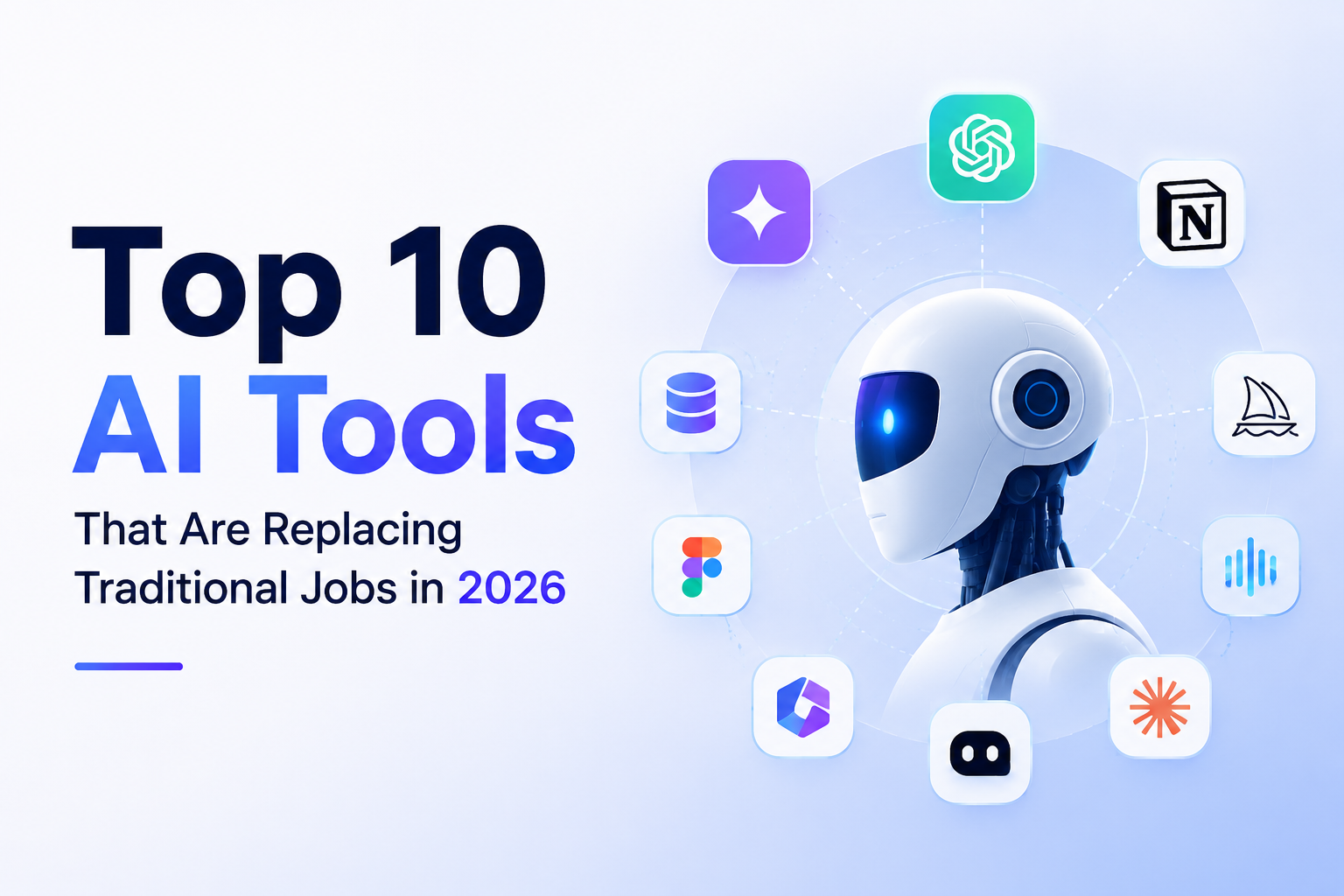
Top 10 AI Tools That Are Replacing Traditional Jobs in 2026
1. ChatGPT
ChatGPT has become one of the most popular AI tools globally.
It helps users with:
- Writing articles
- Drafting emails
- Creating marketing copy
- Brainstorming ideas
- Answering questions
- Automating customer support
Businesses now use ChatGPT to reduce time spent on repetitive writing tasks.
Traditional roles affected include:
- Basic content writers
- Customer support agents
- Data entry assistants
- Research assistants
However, skilled writers and strategists are still essential for originality, creativity, and brand voice.
2. Google Gemini
Google Gemini is deeply integrated into Google Workspace and productivity tools.
It helps users:
- Summarize documents
- Analyze spreadsheets
- Generate presentations
- Organize meeting notes
- Conduct AI-powered research
Many office productivity tasks that once required manual effort are now being streamlined using Gemini.
Administrative and reporting jobs are experiencing major workflow changes due to AI integration.
3. Midjourney
Midjourney is an advanced AI image generation platform.
Users can create professional artwork simply by typing text prompts.
Industries impacted include:
- Graphic design
- Advertising
- Social media marketing
- Branding
- Illustration
Businesses can now generate concept visuals in minutes instead of spending days on manual revisions.
While AI cannot fully replace creative professionals, it significantly speeds up visual production workflows.
4. Canva AI
Canva AI has transformed graphic design for non-designers.
Features include:
- AI-generated templates
- Instant presentations
- AI image generation
- Background removal
- Social media content creation
Small businesses and creators now use Canva AI instead of hiring designers for basic tasks.
This has changed freelance design markets significantly.
However, advanced branding and premium design work still require skilled designers.
5. Jasper AI
Jasper AI is widely used for marketing and business content creation.
It helps generate:
- Blog posts
- Product descriptions
- Website copy
- Social media captions
- Advertising content
Digital marketing agencies use Jasper AI to scale content production quickly.
Traditional repetitive copywriting work is increasingly automated using AI writing assistants.
6. GitHub Copilot
GitHub Copilot acts as an AI coding assistant for developers.
It helps programmers:
- Generate code suggestions
- Detect coding errors
- Automate repetitive coding tasks
- Learn programming syntax faster
Software developers are now using AI-assisted coding to improve efficiency.
Although AI helps with coding, human developers are still needed for problem-solving, architecture, and complex software decisions.
7. Synthesia
Synthesia is changing video production using AI avatars and voice generation.
Businesses use it for:
- Employee training videos
- Educational content
- Product explainers
- Corporate communication
- Marketing videos
Traditional video production tasks like filming and editing basic informational videos are now heavily automated.
This saves businesses both time and money.
8. Notion AI
Notion AI improves productivity and workplace organization.
It assists with:
- Note summarization
- Content drafting
- Task organization
- Workflow management
- Project planning
Administrative professionals and office teams use Notion AI to automate documentation and improve efficiency.
9. Grammarly AI
Grammarly AI has evolved beyond simple grammar correction.
In 2026, it now helps users:
- Improve writing clarity
- Rewrite content
- Adjust writing tone
- Generate suggestions
- Improve professional communication
Students, businesses, and professionals use Grammarly daily to improve written communication quickly.
10. Runway ML
Runway ML is revolutionizing AI-powered video editing.
It provides:
- AI video generation
- Automatic editing
- Motion tracking
- Background removal
- Visual effects creation
Content creators and marketers use Runway ML to reduce editing time dramatically.
AI video editing is becoming increasingly important in the creator economy.
Industries Most Affected by AI
Some industries are adapting to AI faster than others.
1. Customer Support
AI chatbots now handle a large percentage of routine customer inquiries.
2. Marketing
AI tools automate ad targeting, analytics, copywriting, and content scheduling.
3. Content Creation
AI writing and design platforms are speeding up content production.
4. Finance
AI systems help with fraud detection, reporting, and data analysis.
5. Education
AI tutors and personalized learning systems are becoming more common.
6. Software Development
AI coding assistants are improving development speed and productivity.
Will AI Replace Humans Completely?
This is one of the biggest concerns people have today.
The truth is that AI is unlikely to replace humans entirely.
AI performs best with repetitive, data-driven, and predictable tasks.
Humans still outperform AI in areas such as:
- Creativity
- Emotional intelligence
- Leadership
- Human relationships
- Critical thinking
- Strategic planning
The future is more likely to involve collaboration between humans and AI rather than total replacement.
People who adapt and learn AI-related skills will have better career opportunities in the coming years.
Skills That Will Stay Valuable in the AI Era
As AI grows, certain human skills will become even more important.
Creativity
Original thinking and creativity remain difficult for AI to fully replicate.
Communication Skills
Strong communication and relationship-building abilities will continue to be highly valuable.
Critical Thinking
Humans are still better at understanding complex emotional and ethical situations.
AI Tool Management
Knowing how to use AI tools effectively is becoming a major professional advantage.
Personal Branding
People with strong personal brands and unique expertise will stand out even in an AI-driven world.
Future of Jobs in the AI Era
The job market is changing rapidly.
Many repetitive jobs may disappear, but entirely new career opportunities are also emerging.
New AI-related careers include:
- AI prompt engineers
- AI consultants
- AI workflow specialists
- AI content strategists
- AI automation experts
Businesses now prefer professionals who can combine human creativity with AI efficiency.
Instead of avoiding AI, learning how to work alongside it is becoming essential.
Final Thoughts
AI tools are transforming industries at an incredible speed in 2026.
While some traditional job roles are being automated, AI is also opening new doors for innovation, productivity, and business growth.
The smartest approach is not to fear AI but to understand how to use it effectively.
Businesses that adopt AI strategically can improve efficiency and reduce costs, while individuals who learn AI skills can stay competitive in the modern workforce.
The future belongs to people who continuously adapt, learn, and evolve alongside technology.
Key Takeaway
AI tools are replacing repetitive tasks across industries, but they are also creating new opportunities for skilled professionals. Learning how to use AI effectively is becoming one of the most valuable digital skills in 2026 and beyond.